1
Civil penalty charge notices (Councils, TFL and so on) / Re: Bus lane PCN Southwark Council
« on: Yesterday at 06:00:22 pm »
I am here to submit reps whenever you are ready
 Show Posts
This section allows you to view all posts made by this member. Note that you can only see posts made in areas you currently have access to.
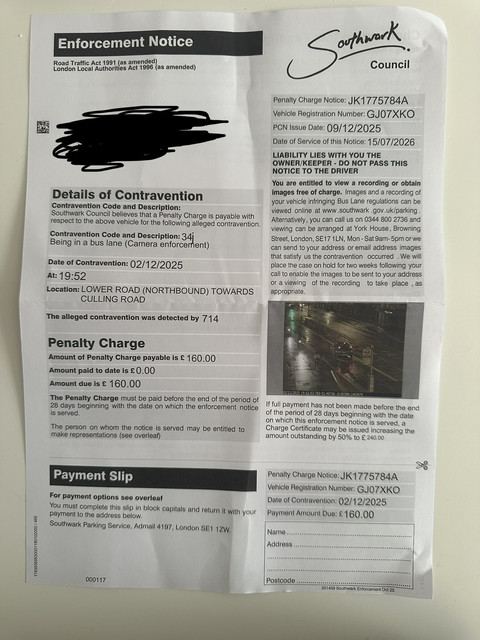
The date of service?I'm not sure that is unreasonable, if the EN is posted two days earlier which was yesterday, or maybe last Friday 10th July. I say this because Schedule 1 of the LLA Act 1996 says this regarding EN content: -
Which says 15/07/2026, which is impossible as you cannot have served something in the future.Quote(2)An enforcement notice must state—So really the "served on" date is an anticipated date based on postage times and therefore tells the recipient that the council will start counting the 28 days from that date. Of course the word "anticipated" isn't on the EN. so maybe it is wrong.
(a)the amount of the penalty charge payable;
(b)the grounds on which the council believe that a penalty charge is payable with respect to the vehicle;
(c)that the penalty charge must be paid before the end of the period of 28 days beginning with the date on which the enforcement notice is served;
(d)that failure to pay the penalty charge may lead to an increased charge being payable;
(e)the amount of that increased charge;
(f)that the person on whom the notice is served may be entitled to make representations under paragraph 2 below; and
(g)the effect of paragraph 6 below.
Ah, yes, butBasically, the law is that the dropped length of kerb must not be blocked. So if one's car is adjacent only to the sloping kerbstone, no contravention has been committed, because it is obviously not droppped, but councils still force their CEOs to serve PCNs for such cases. In many cases this is because a resident has complained, so they keep them quiet by serving a PCN.
you said
“ The sloping kerbstones don't count even if councils think they do.”
I thought this was maybe something to do with the dropped curb and how it’s designed
Of course some dropped sections don't have "transition" (sloping) kerbstones, but a 90degree kerb section. In these instances, one is either by the raised kerb or not, no argument.

Just because someone says it doesn’t mean that it’s true.Some of us know more than some of the tribunal adjudicators, who are lawyers but vary in their knowledge although they are supposed to be appraised.
I tend to often find this to be the case that enthusiastic laymen surpass professionals in their knowledge and expertise.
Some of us know more than some of the tribunal adjudicators, who are lawyers but vary in their knowledge although they are supposed to be appraised.