Show Posts

This section allows you to view all posts made by this member. Note that you can only see posts made in areas you currently have access to.

Messages - imnotpaying

Pages: [1] 2 3
1
yes

Hi @b789,

I have received a few letters demanding payment, with the last one from GCTT Certificated Enforcement Agents on 13/01/26 claiming 'Notice to Transfer to Solicitors'.
I guess these letters can go into the shredder?

2
You have my e mail address?
yes.  I've emailed the video, NTK and NOR to you.

@Hippocrates, hope you're doing well.  Did you have a chance to look at my email? please let me know the grounds I should write the Tribunal appeal on?
Looking forward to your advice.

3
You have my e mail address?
yes.  I've emailed the video, NTK and NOR to you.

4
If you want us to comment on the video evidence, we'll need to see it (or have access to it).

The video is not available on Redbridge PCN site as it says 28 days have passed.
I do have a copy of it but no idea how to share it on here - I can email to you if you like.

5
They have missed the point and they have misstated what the PCN says on page two. I cannot find any reference to chapter three.

Indeed, they completely missed the point. Can we bring the same argument to the Tribunal? 

6
Yes. Let's see how they respond.

Hi @Hippocrates,

I have received an NOR from Redbridge.  Their argument is that their wording for Charge Certificate is correct and there NTK is correct.  See the full response below:


Have a read through and let me know your thoughts please.

7

I suggest you respond to POPLA with the following, for the record:


Thank you for taking the time to write this up.
I have sent the email exactly as you've written to POPLA.
Should I proceed with complaining to the DMCC and local MP already?


8

When you get a response from POPLA, please show it to us.


Hi @b789,  I have received a response to my complaint to POPLA.  Please see below:


Thank you for your email. This has been passed to me by the POPLA Team as I am responsible for handling complaints.

I note from your correspondence that you are unhappy with the decision reached by the assessor in your appeal against MET Parking Services.

POPLA is an impartial and independent appeals service, and we do not act either for the parking operator or the appellant. It is important to explain that it is not our remit to source evidence and documents from either party in support of their submission, and our decisions are based on the evidence received from both parties at the time of the appeal. We cannot consider further evidence after the appeal has been completed.

Our assessors have been trained on relevant law, the Private Parking Sector Single Code of Practice, and our decision-making guidelines. They have also passed an intensive accreditation process following our training programme and receive regular internal quality audits as well as coaching and personal development.

POPLA is a one-stage process, and we would not change a decision because either party disputes the assessor’s decision. However, we may consider an appeal if there has been a procedural error, for example – if we failed to allow a motorist to comment on a parking operator’s evidence pack. My role as a complaint’s handler is to determine whether a procedural error occurred during the assessment of your appeal.

Having read your complaint, I have noted your following points and will address each one individually:

A single timestamp on the PCN does not constitute a period of parking under the Protection of Freedoms Act 2012 (PoFA).
 
Below I will provide the period of parking from the PCN:


The PCN states the charge relates to the period of parking immediately prior to 16:57.
 

Here is the enlarged copy of the photograph of the parked vehicle on the notice to keeper:
 

The photograph shows a timestamp of 16:52, which is prior to 16:57. The PCN also offers the option to review any further photographic evidence of the contravention. I agree with the assessor’s assertation that the period of parking has been fully established on the PCN.

You raise it is not your responsibility as the registered keeper to provide the driver’s details.

I accept there is no legal requirement for you to name the driver. However, by not doing so, you accept that you can be held liable for the PCN as the registered keeper under PoFA 2012. I agree with the assessor that the parking operator has issued a fully compliant notice to keeper under this legislation.

You are unhappy that the assessor disregarded the court cases raised as they did not set a precedent.

The county court cases that you raised only have persuasive authority and it is not binding. Ultimately, both Brennan v Premier Parking Solutions (2023) and VCS v Edward (2023) involved different parking operators, so language used on the PCNs may differ. The assessor based their judgement on the evidence specific to this case and was satisfied that the parking operator met the provisions of PoFA 2012 and successfully transferred liability to the registered keeper.

You state that the assessor is incorrect that a consideration period does not apply for parking within a marked bay.
 
Section 5.1 of the Single Code of Practice states that parking operators must allow a consideration period of appropriate duration, subject to the requirements set out in Annex B to allow a driver time to decide whether to park. The minimum consideration period is five minutes, and this can end sooner if there is evidence that the driver has left the location e.g. by observation by an attendant.

The parking operator provided several images of your vehicle parked across the two bays over the period of five minutes. It also provided a photo of the nearest sign to the vehicle which was taken within this time period. I am satisfied that there is sufficient evidence that the consideration period had ended and the parking contract was accepted.
As all the evidence provided has been considered, no procedural error has occurred and therefore, the outcome will not change. As POPLA is a one-stage process, there is no opportunity for you to appeal the decision.

You are still free to dispute your parking charge through other channels, such as the courts, if you wish to do so. For independent legal advice, please contact Citizens Advice at: www.citizensadvice.org.uk or call 0345 404 05 06 (English) or 0345 404 0505 (Welsh).

To conclude, I am sorry that you have not had a positive experience when using our service. POPLA’s involvement with your case has now ended, and my response closes our complaints process. I must advise there will be no further review of your complaint and any further correspondence on the matter will not be responded to.
 
Yours sincerely,

9
Can I please get any advice on how to proceed with this PCN please?

10
Who's 'we' pl?

Only the person* to whom the PCN is addressed has liability here for the moment.

https://maps.app.goo.gl/QTCgAH4g2UJ66wnh8

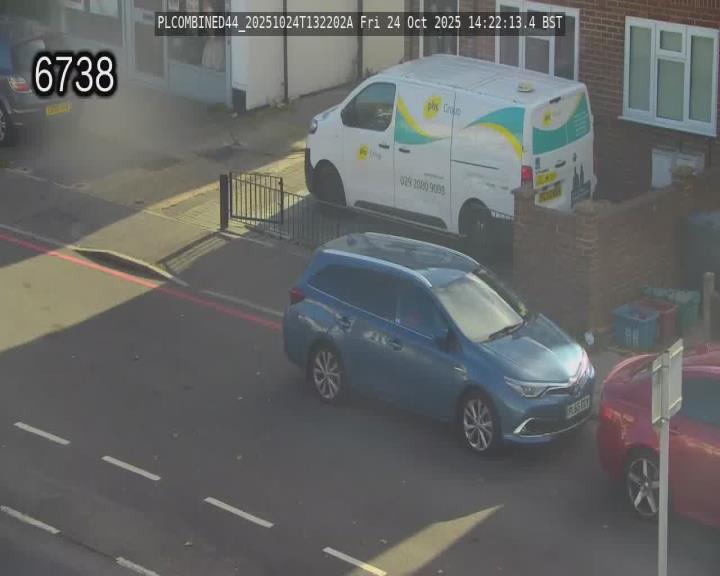
Suggests the red line extends under the car and IMO would be taken as proof by an adjudicator unless the RK could show otherwise.


*- normally the registered keeper. Possibly a corporate entity. Pl confirm.

RK is a member of family of mine for his car, so no corporate entity.

11
Hi,

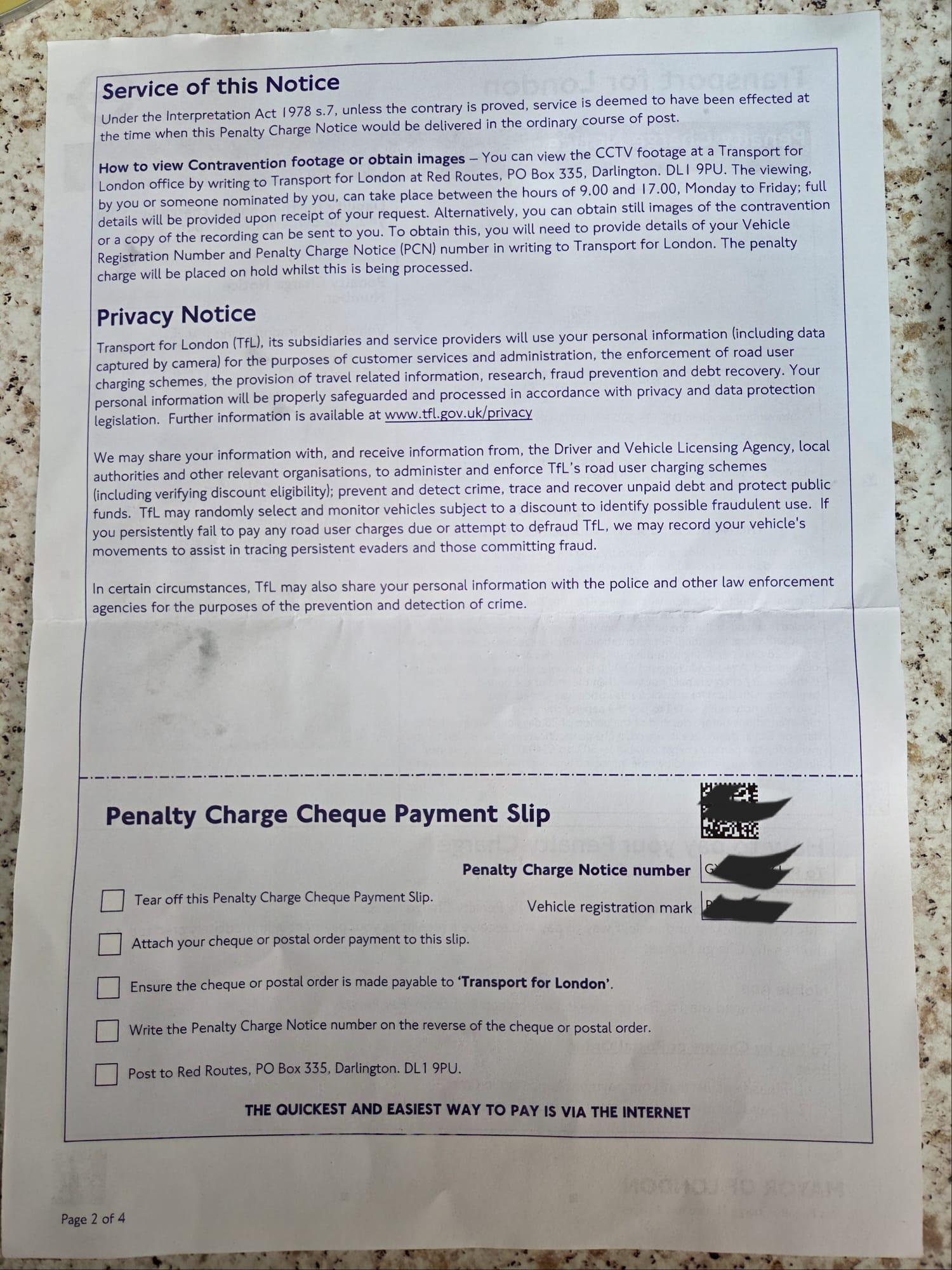
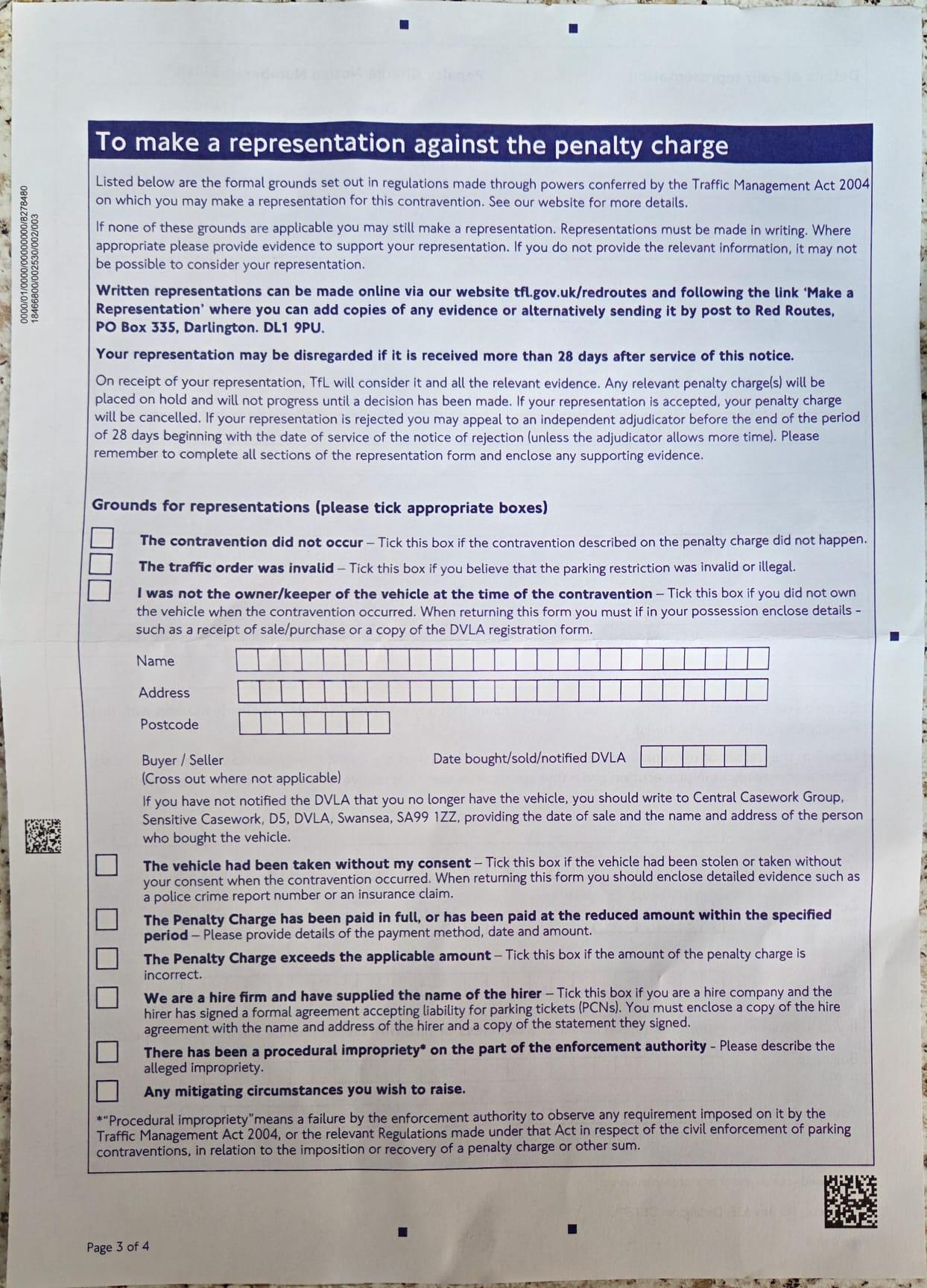
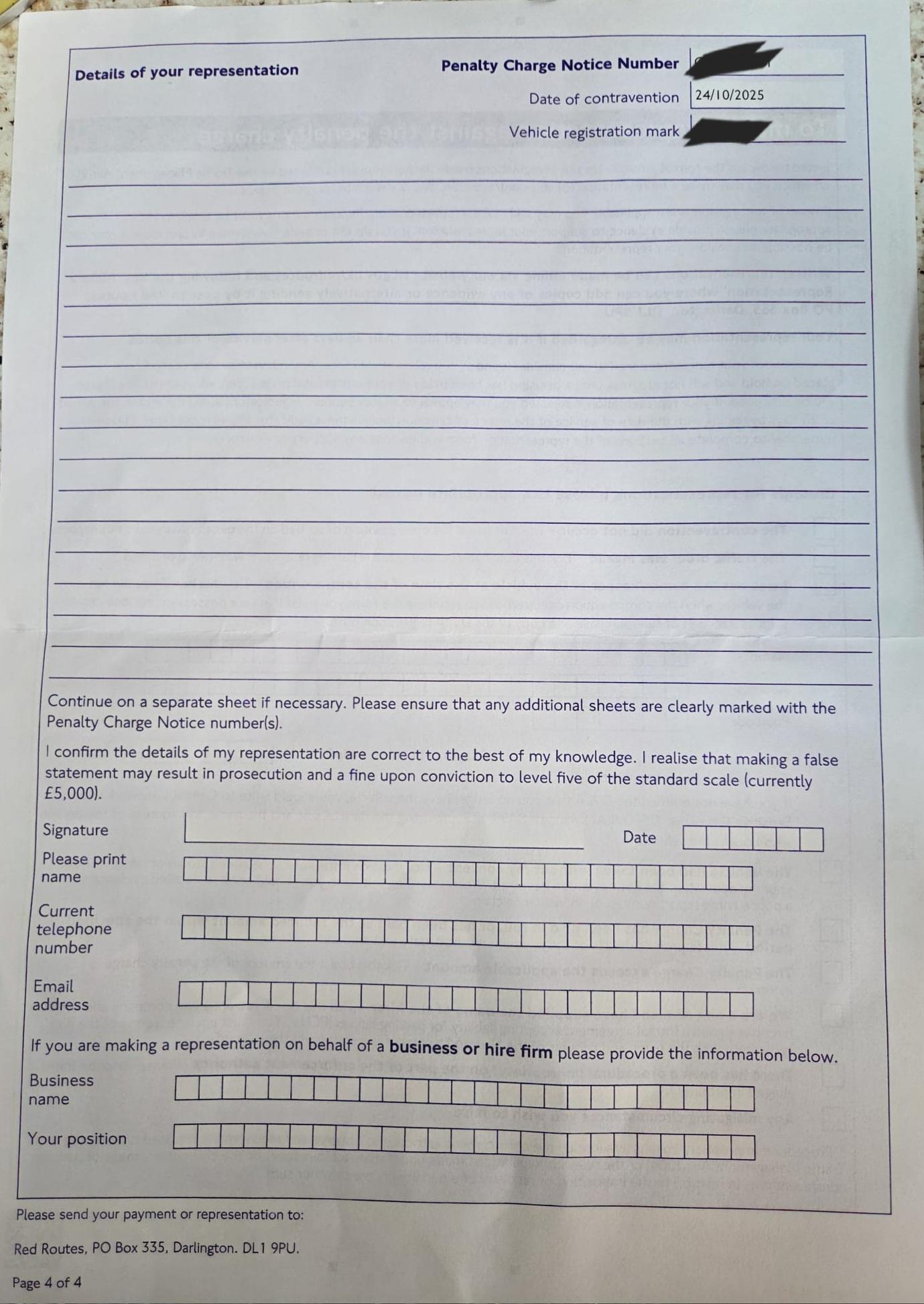
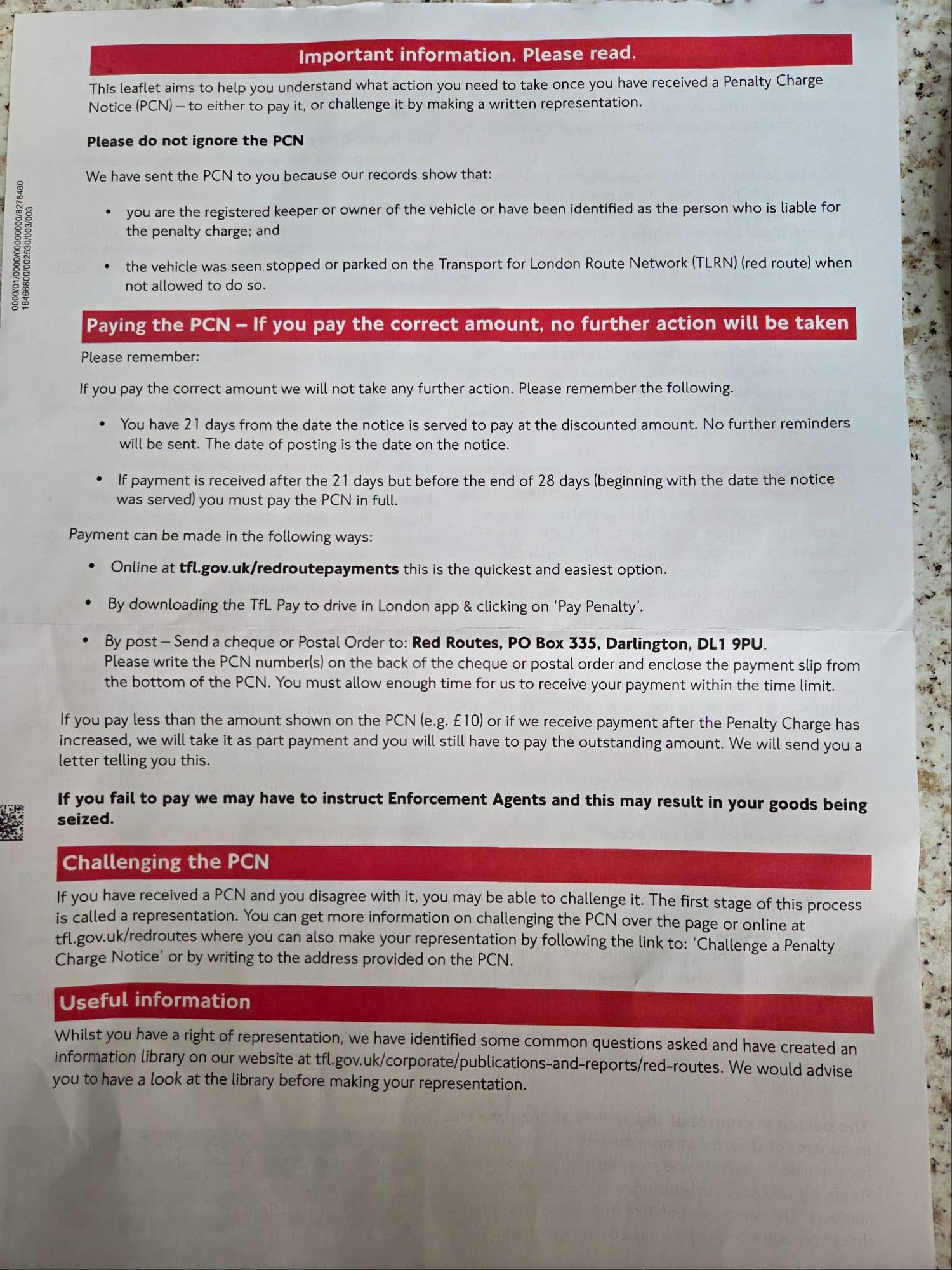
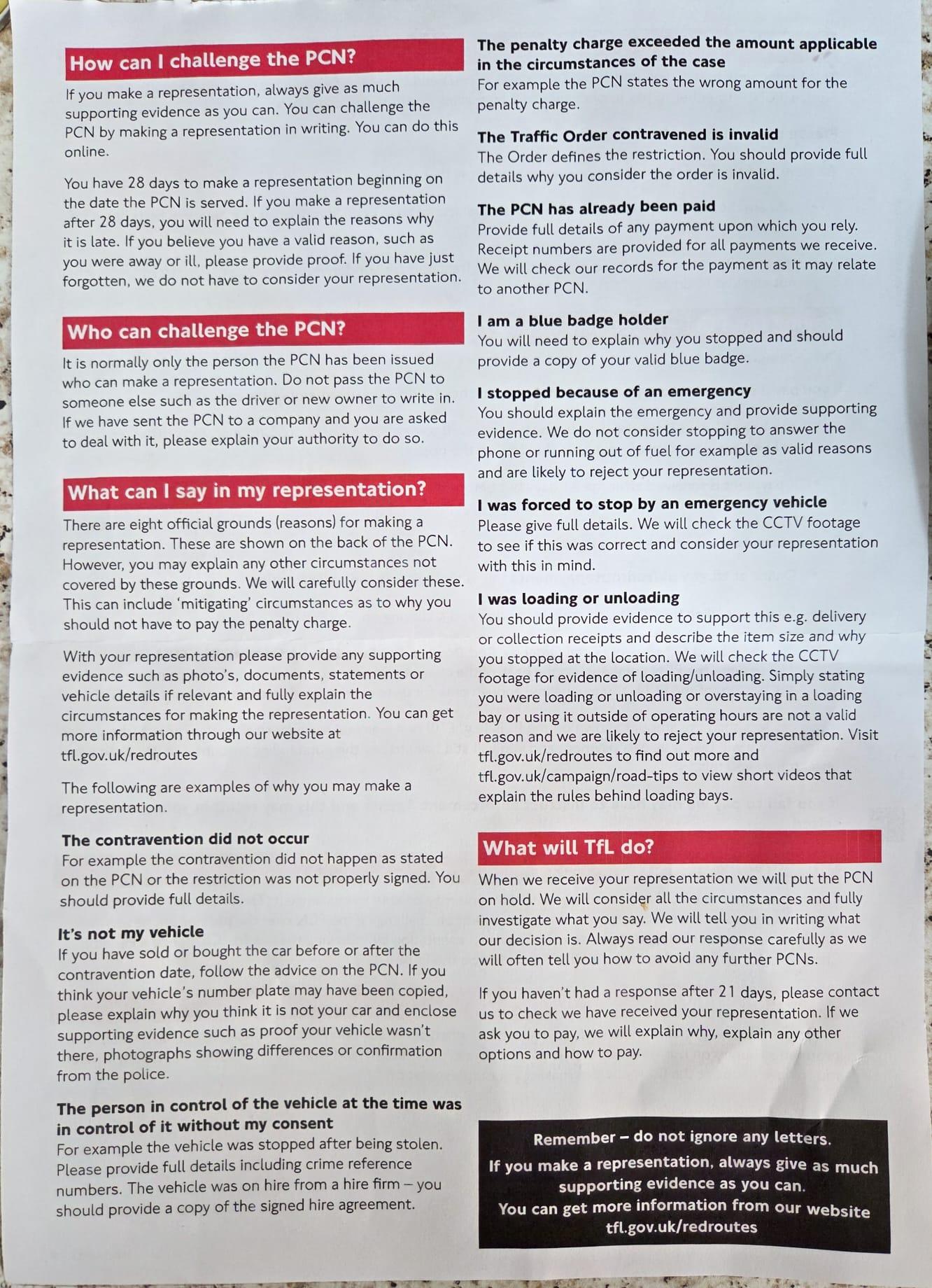
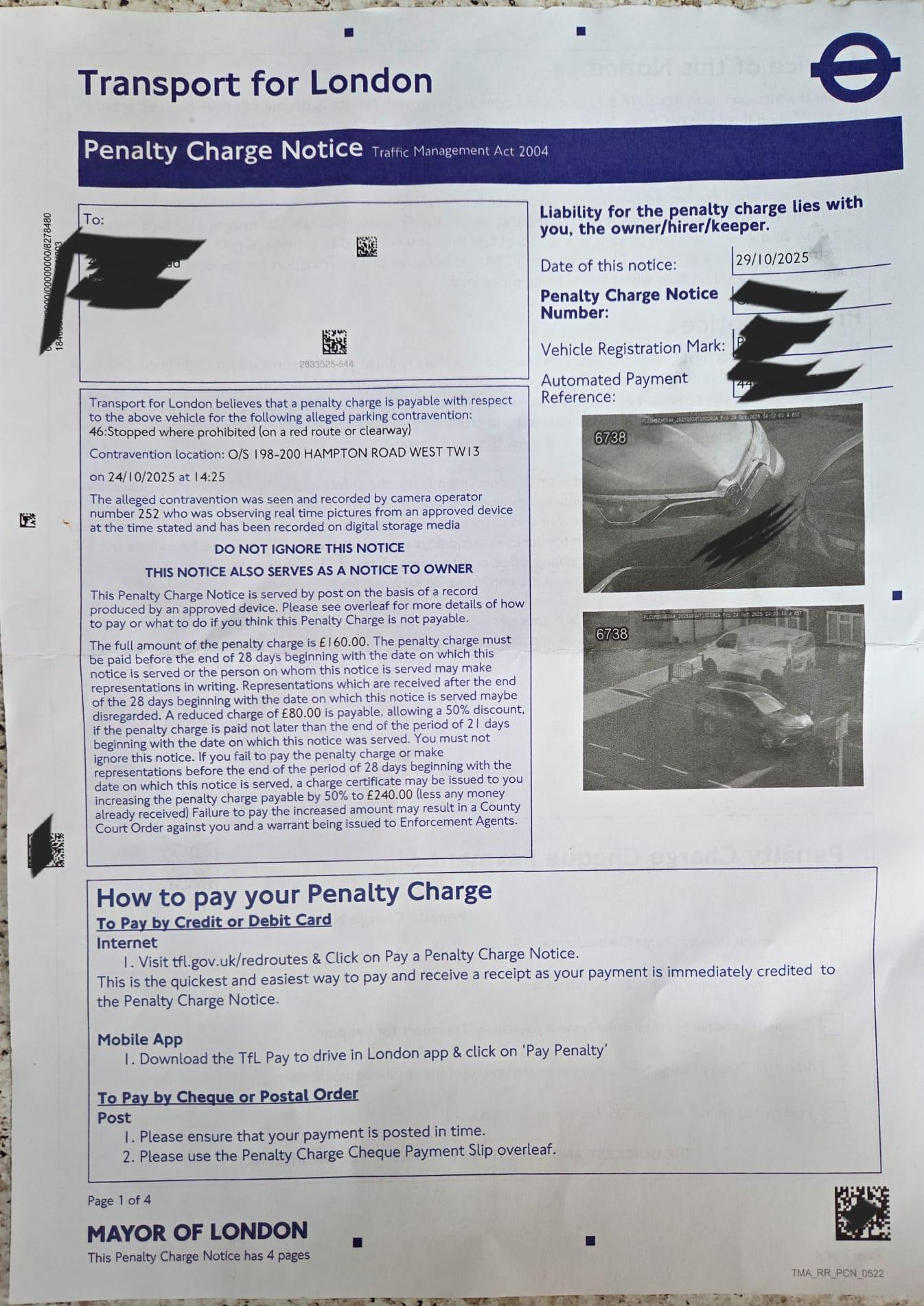
Recently received this PCN from TFL for Code 46 - stopped on a red line.
The images provided by TFL do not actually show the car parked on a red line.  Please find the PCN details below. 
On what grounds can we possibly fight this?

Thank you for your time to look at this.


12
Yes. Let's see how they respond.

Thank you Phil, I've sent the below representation to Redbridge:

I make this collateral challenge against the validity of the PCN as it is missing mandatory information as provided at Para. 4 (8) (v) of Section 4 of the London Local Authorities and Transport for London Act 2003 (https://www.legislation.gov.uk/ukla/2003/3/section/4/enacted)

(v)that, if the penalty charge is not paid before the end of the 28 day period, an increased charge may be payable.

Clearly, this refers to Para. 4 (8) (iii):
(iii)that the penalty charge must be paid before the end of the period of 28 days beginning with the date of the notice;

Therefore, it follows that the statement: "If you fail to pay the Penalty Charge or make representations before the end of a period of 28 days beginning with the date of service of this notice an increased charge of £240 may be payable” adds to the lack of clarity by its omission. Even on its own, whether the required information was included or not, it is also arguable that it conflates the two periods using the word "or" which many would view as being conjunctive. Furthermore, even if the statement were to be interpreted disjunctively, there is still no clarity due to the missing information. So, it follows that it cannot possibly be interpreted disjunctively.

Additionally, the locus as stated on the PCN is inexact.

In light of the above, please cancel the PCN.

13
Locus and PCN missing information. re the latter, see my recent posts and/or Flame Pit thread.


Hi @Hippocrates, I've read your input in the Flame Pit thread.  Is the below applicable in my appeal:


I make this collateral challenge against the validity of the PCN as it is missing mandatory information as provided at Para. 4 (8 ) (v) of


https://www.legislation.gov.uk/ukla/2003/3/section/4/enacted

(v)that, if the penalty charge is not paid before the end of the 28 day period, an increased

charge may be payable.

Clearly, this refers to Para. 4 (8 ) (iii):

(iii)that the penalty charge must be paid before the end of the period of 28 days beginning

with the date of the notice;

Therefore, it follows that the statement: "If you fail to pay the Penalty Charge or make representations before the end of a period of 28 days beginning with the date of service of this notice an increased charge of £240 may be payable” adds to the lack of clarity by its omission. Even on its own, whether the required information was included or not, it is also arguable that it conflates the two periods using the word "or" which many would view as being conjunctive. Furthermore, even if the statement were to be interpreted disjunctively, there is still no clarity due to the missing information. So, it follows that it cannot possibly be interpreted disjunctively.

14
If further evidence that POPLA assessors, especially this moronic feckwit, are not legally trained and prove beyond any reasonable doubt that they are intellectually malnourished, this decision is clear evidence that they are not fit for purpose.

1. PoFA 9(2)(a): basic statutory error
They equate a single timestamped photo with a “period of parking”. That is plainly wrong. A period requires a duration. Saying the NtK “contains the period parked” because it shows a date/time is legally indefensible.

2. Keeper liability: burden flipped and law misstated
They assert it’s the registered keeper’s “responsibility” to name the driver. It isn’t. The operator can pursue the keeper only if (and because) the NtK is fully PoFA-compliant. No compliance, no keeper liability. The assessor reverses that scheme.

3. Consideration period: concept misunderstood
They claim no consideration period applies because the vehicle was “out of bay”. Consideration is about pre-contract opportunity to find and read terms. Whether a breach later occurred is irrelevant to whether that minimum five-minute window had to be allowed and evidenced. The assessor’s position is circular.

4. Contract formation: assumption standing in for analysis
“By parking on site a contract was formed” is a conclusion, not reasoning. Formation depends on opportunity to see and digest the terms. One timestamp cannot prove acceptance—especially when the operator’s own case tops out at “~5 minutes observed”.

5. Persuasive authority: wrong standard, wrong dismissal
They dismiss cited County Court appeal decisions wholesale as “cannot set a precedent”. Correct: they’re not binding. But they are persuasive—and directly on point about “period of parking”. Ignoring them because they’re not binding is an intellectual cop-out.

6. “Curing” NtK defects with an evidence pack
They treat later photos/narrative as if they can retrofit missing NtK content. PoFA compliance is determined from the NtK itself. Post-hoc material cannot mend an omission in a statutory notice. The assessor never engages with that.

7. Signage: transitional rules over-stretched
Referring to legacy BPA signage provisions during the transition does not displace other live Single Code duties (like consideration). The assessor uses signage compliance to sidestep the separate questions of formation and PoFA content. That’s a non sequitur.

8. Landowner authority: relevance blurred, Beavis misused
Beavis says nothing about whether a redacted “licence” actually confers authority to issue and litigate in the operator’s own name for this site. The assessor accepts a highlighted, redacted document at face value without testing mandatory particulars the Code requires.

9. Evidential threshold: photos ≠ strict proof
“Series of photos” showing a tyre over a line may evidence the alleged posture of the vehicle. They do not evidence (a) the period of parking for PoFA, or (b) that a contract was actually formed after adequate opportunity to read terms. The assessor conflates breach proof with liability route.

10. Failure to engage with the core point
The appeal’s fulcrum was narrow and statutory: no period of parking on the face of the NtK. The decision ducks that question, replaces it with generalities about signage, and pronounces keeper liability as if it were automatic. It isn’t.

Bottom line
This decision is legally unsound. It misstates PoFA, ignores directly relevant persuasive authority, confuses formation with breach, and tries to graft later evidence onto a defective NtK. In short: assertion in place of analysis, conclusions in place of reasoning.

The decision is not binding on you and you DO NOT pay anything. I will draft a formal complaint to POPLA, which will not get them to reverse their decision, irrespective of whether they are with the complaint but it puts them on record as to their utter incompetence and that it will not be soon enough when they become an irrelevance once the Private Parking (Code of Practice) Act 2019 is eventually brought into play.

From now on, you can safely ignore all useless debt recovery letters. Debt collectors are powerless to do anything except to try and intimidate the low hanging fruit on the gullible tree into paying out of ignorance and fear. Come back if/when ou receive a Letter of Claim (LoC) and we will advise on how to bring this to a conclusion without having to pay a penny to these scammers.

In the meantime, I advise you to send the following formal complaint about this idiot POPLA assessor with the following to info@popla.co.uk and CC yourself:

Quote
Subject: Formal Complaint – Incompetent and Legally Defective Adjudication by POPLA Assessor [assessor name]

To: POPLA Complaints Team

Dear POPLA Complaints Team,

I am writing to lodge a formal complaint about the standard of adjudication in my recent POPLA appeal against MET Parking Services. The assessor’s decision is not merely wrong in law; it is so bereft of legal reasoning that it raises serious questions about the competence, training, and impartiality of your adjudication staff.

While I am fully aware that POPLA’s complaints process never overturns a decision — regardless of how egregiously flawed — I require a written response to this complaint for submission to my Member of Parliament and other oversight bodies. The manner in which this appeal has been handled exemplifies why public confidence in POPLA has collapsed: decisions are routinely reached by individuals who appear neither legally trained nor intellectually equipped to apply the very legislation they cite.

1. Statutory Illiteracy – PoFA 9(2)(a)
The assessor treated a single timestamp on the Notice to Keeper as satisfying the statutory requirement to “specify the period of parking”. This is legally absurd. A single timestamp represents an instant, not a duration, and therefore cannot constitute a “period”.
This is not a matter of interpretation — it is a matter of plain English and binding statutory drafting. The point has been clarified in persuasive appellate authority, Brennan v Premier Parking Solutions (2023), where the judge expressly ruled that an instant in time cannot evidence a period of parking.

By failing to grasp that fundamental distinction, the assessor has demonstrated a level of incompetence that is wholly incompatible with any adjudicative role.

2. Reversal of the Burden of Proof
The assessor stated that it was the keeper’s “responsibility” to name the driver and that liability “remains with the registered keeper”. That is the opposite of what PoFA provides. The Act creates a narrow and conditional statutory exception allowing keeper liability only if the operator has issued a fully compliant NtK.

The keeper has no legal duty whatsoever to identify the driver. The assessor has completely inverted the law. This is not a borderline interpretative issue — it is a fundamental misunderstanding of the legislative scheme POPLA was created to apply.

3. Refusal to Acknowledge Persuasive Authority
The assessor’s refusal to consider Brennan v Premier Parking Solutions and VCS v Edward on the grounds that “county court cases cannot set precedent” betrays a lack of even the most rudimentary legal training. These were appellate decisions, which, while not binding, are persuasive — a concept clearly beyond the assessor’s comprehension.

To summarily dismiss them rather than engage with the reasoning within those judgments is intellectually negligent and incompatible with the role of an adjudicator purporting to apply statutory law.

4. Post-Hoc “Evidence” Used to Cure a Defective NtK
The assessor accepted that later evidence in the operator’s “evidence pack” could retrospectively fix omissions in the original NtK. That is simply wrong.

PoFA compliance is judged on the face of the notice as issued. The Act does not permit later materials to “cure” a statutory defect. This is basic procedural fairness. The assessor’s failure to understand this undermines the entire purpose of the PoFA regime.

5. Misunderstanding of the Consideration Period
The assessor dismissed the argument regarding the mandatory consideration period under Section 5.1 of the Private Parking Single Code of Practice, asserting that none applied because the driver “was parked out of a bay”. This is nonsensical.

The consideration period exists before a parking contract is formed and applies regardless of where the vehicle stops. It is designed to give a motorist time to locate, read, and understand the terms before deciding to stay. The assessor’s logic that “no consideration period applies if the terms were breached” is circular, incoherent, and wrong in law.

6. Blind Acceptance of Operator Assertions
The assessor’s entire reasoning rests on unverified assertions from the operator — including redacted, unsigned “contracts” and generalised claims of signage adequacy. The evidence was accepted at face value, while every legally grounded argument from the appellant was ignored. This asymmetric scrutiny is not impartial adjudication; it is de facto advocacy for the operator.

7. Institutional Lack of Accountability
I am under no illusion that POPLA will ever reverse this decision, regardless of how obvious the assessor’s failings are. However, this complaint is being lodged formally so that the resulting correspondence can be placed on record and provided to my MP and the Ministry of Housing, Communities, and Local Government (MHCLG).

POPLA’s refusal to revisit defective decisions, even where basic statutory requirements have been misapplied, reinforces the widespread public perception that it functions not as an independent adjudicator but as an industry shield — an extension of the very trade body it purports to regulate.

8. Requested Actions
1. A full written response addressing each of the points above.
2. Confirmation that the assessor’s legal understanding and decision-making will be reviewed by a senior adjudicator or legally qualified manager.
3. Disclosure of what retraining or disciplinary action, if any, will be taken.
4. A clear statement of POPLA’s position on whether assessors are expected to be legally trained before adjudicating statutory keeper liability cases.

9. Conclusion
This decision is an embarrassment to POPLA and a disservice to the public. It misstates statutory law, disregards persuasive appellate authority, and displays a level of analytical incompetence that renders it unfit for purpose.

If the assessor cannot be retrained to a minimum acceptable standard of legal literacy, then the only appropriate outcome is removal from post. POPLA cannot credibly claim independence or professionalism while tolerating adjudicators who cannot interpret a statute written in plain English.

Yours faithfully,

[Your Full Name]
[Your POPLA Verification Code / Case Reference]

When you get a response from POPLA, please show it to us.


Thank you so much for writing up this email.  I have already sent this to POPLA with the Verification code and assessor name.
And yes, I received a letter from MET Parking requesting payment. I've kept it in my JUNK MAIL/IGNORE folder   ;)

15
I just recently received this PCN from Redbridge Council.
Photo evidence shows the car in the Yellow Box and video evidence shows the car stopped fully for about 10-12 seconds.
The road mentioned in the PCN is High Road, Goodmayes which is quite a long road. 
Is there any possibility of challenging this PCN?  If so, on what grounds or technicalities?


Pages: [1] 2 3