Messages - jaques
-
#1 Re: Liverpool, code 25 Parked in a loading without loading, Mount Pleasant L3
on 16 Jun, 2026 10:56 in Civil penalty charge notices (Councils, TFL and so on)
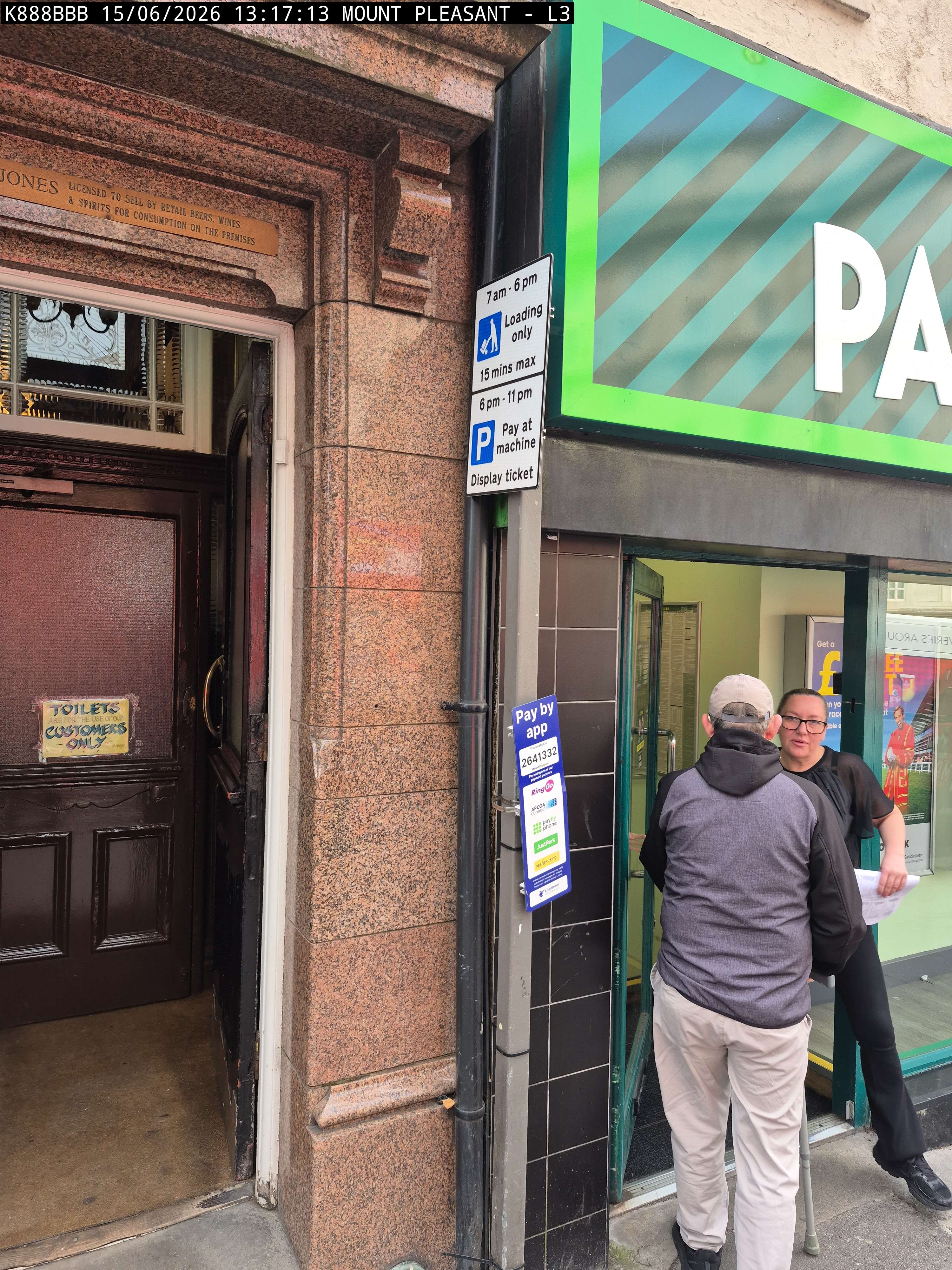
Just to confirm... the fact that the sign with the restrictions is mounted 90º to the street, is not an arguable technical point? -
#2 Re: Liverpool, code 25 Parked in a loading without loading, Mount Pleasant L3
on 16 Jun, 2026 00:12 in Civil penalty charge notices (Councils, TFL and so on)
Thank you. I will pass on the advice. -
#3 Re: Liverpool, code 25 Parked in a loading without loading, Mount Pleasant L3
on 15 Jun, 2026 21:29 in Civil penalty charge notices (Councils, TFL and so on)
More photos tomorrow hopefully. -
#4 Re: Liverpool, code 25 Parked in a loading without loading, Mount Pleasant L3
on 15 Jun, 2026 19:33 in Civil penalty charge notices (Councils, TFL and so on)
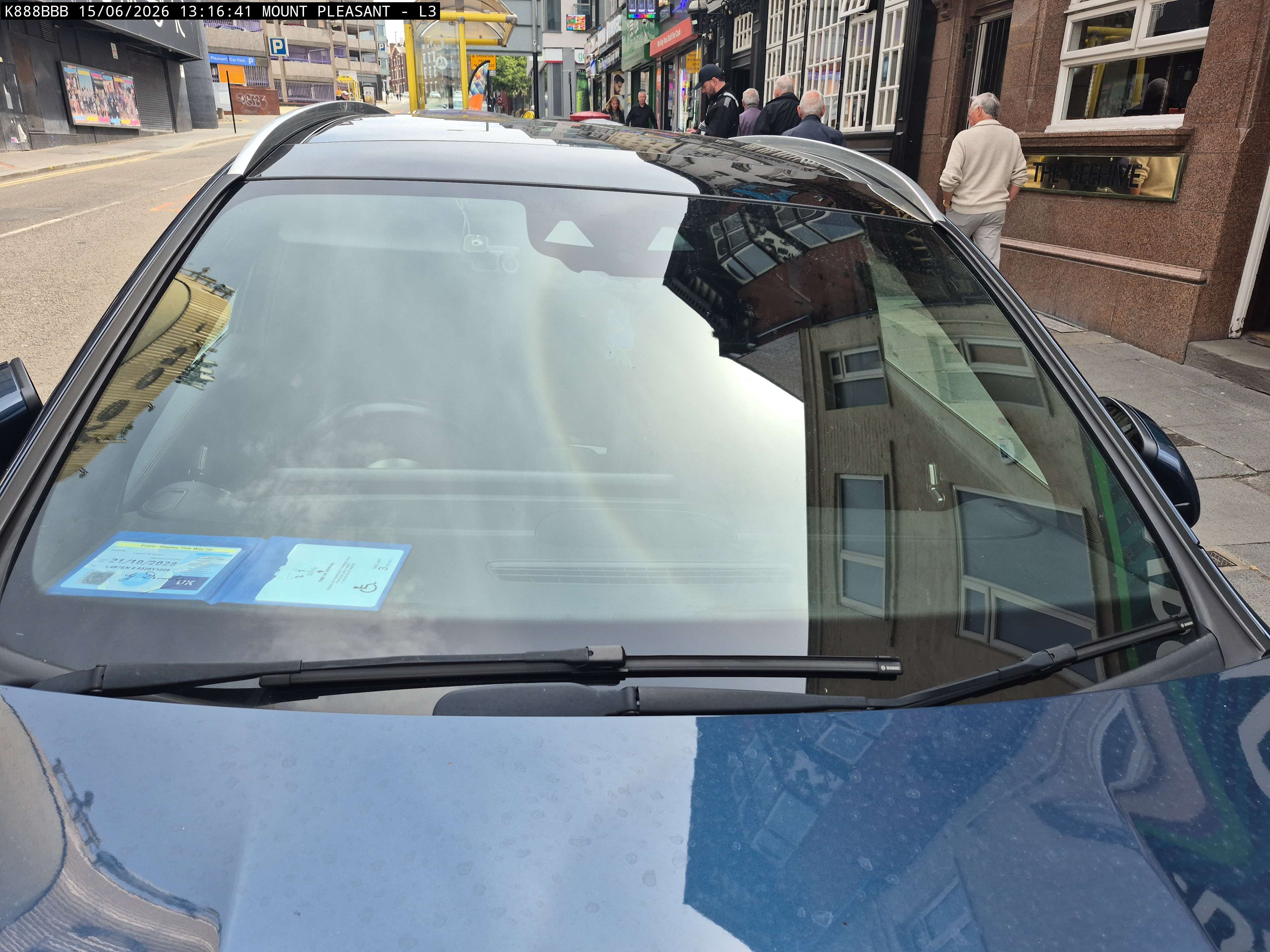
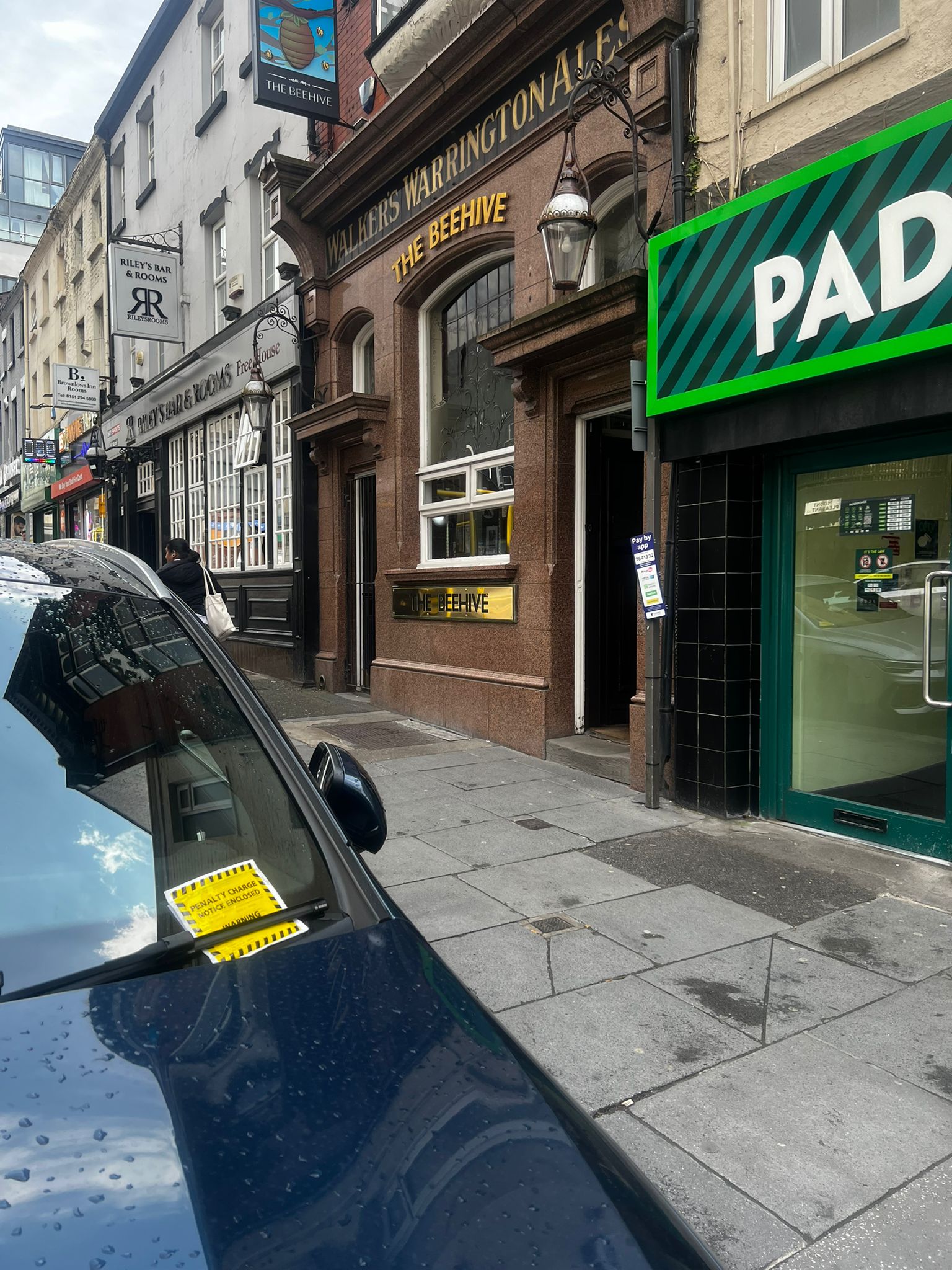
Driver says they saw the Pay and Park sign as that was facing them. A blue badge supposedly allows parking without having to pay. There were no loading markers in the bay as far as the driver was aware, but he will check again tomorrow. The Sign with the times and restrictions is at right angles and not obvious. It was only noticed after the driver returned to the car and saw the PCN. Another car had a ticket on it. People in the betting shop were offering their advice to say the traffic wardens use it to put tickets frequently. -
#5 Re: Liverpool, code 25 Parked in a loading without loading, Mount Pleasant L3
on 15 Jun, 2026 19:04 in Civil penalty charge notices (Councils, TFL and so on)
I'll ask the driver and clarify the thought process behind why they parked there and displayed their BB. -
#6 Liverpool, code 25 Parked in a loading without loading, Mount Pleasant L3
on 15 Jun, 2026 18:32 in Civil penalty charge notices (Councils, TFL and so on)
Driver parked at the bottom of Mount Pleasant. Sign says pay and display, but they got a parking ticket. The driver then looked and noticed that the Sign is at right angles to the street. Seems to be deliberately so you can’t see it. Surely if you’re following the rules you’ve got to be able to see what the rules are. Driver was displaying a blue badge.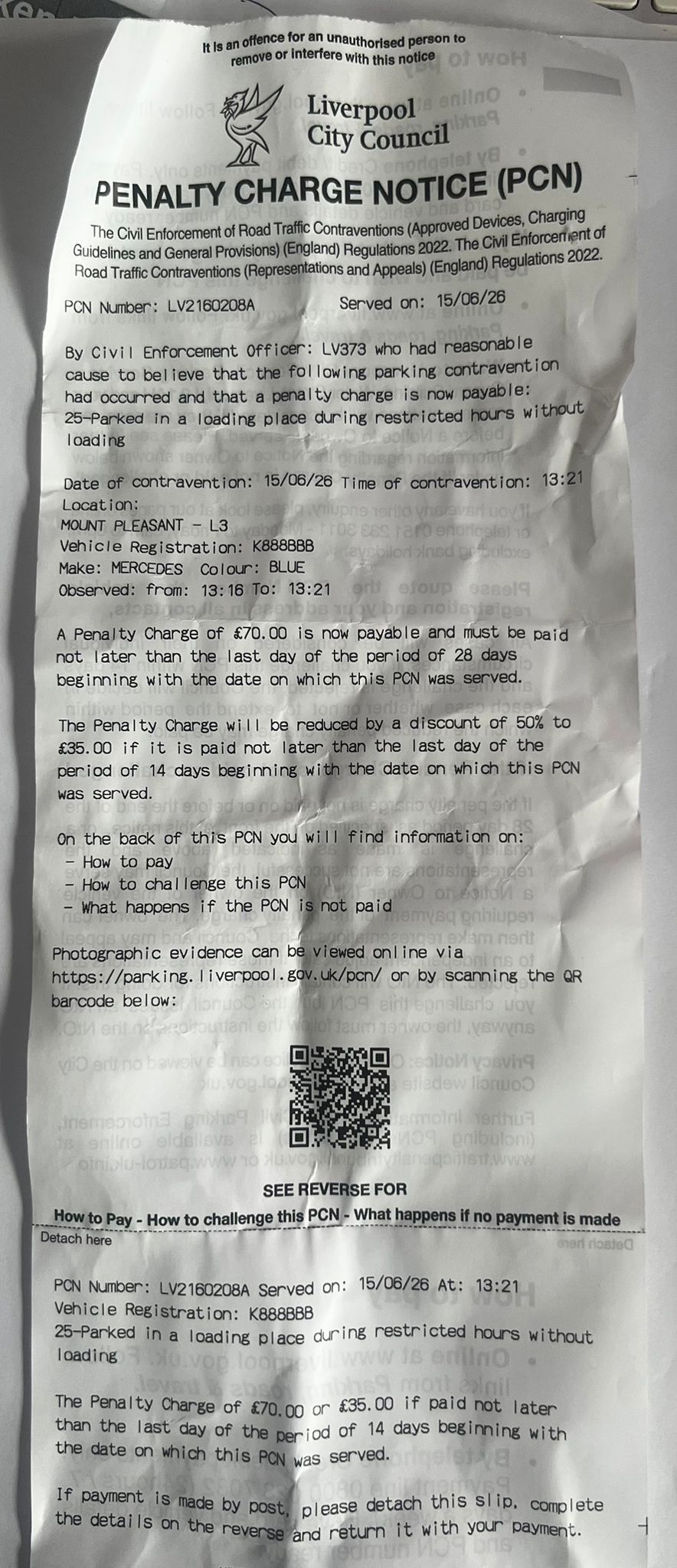
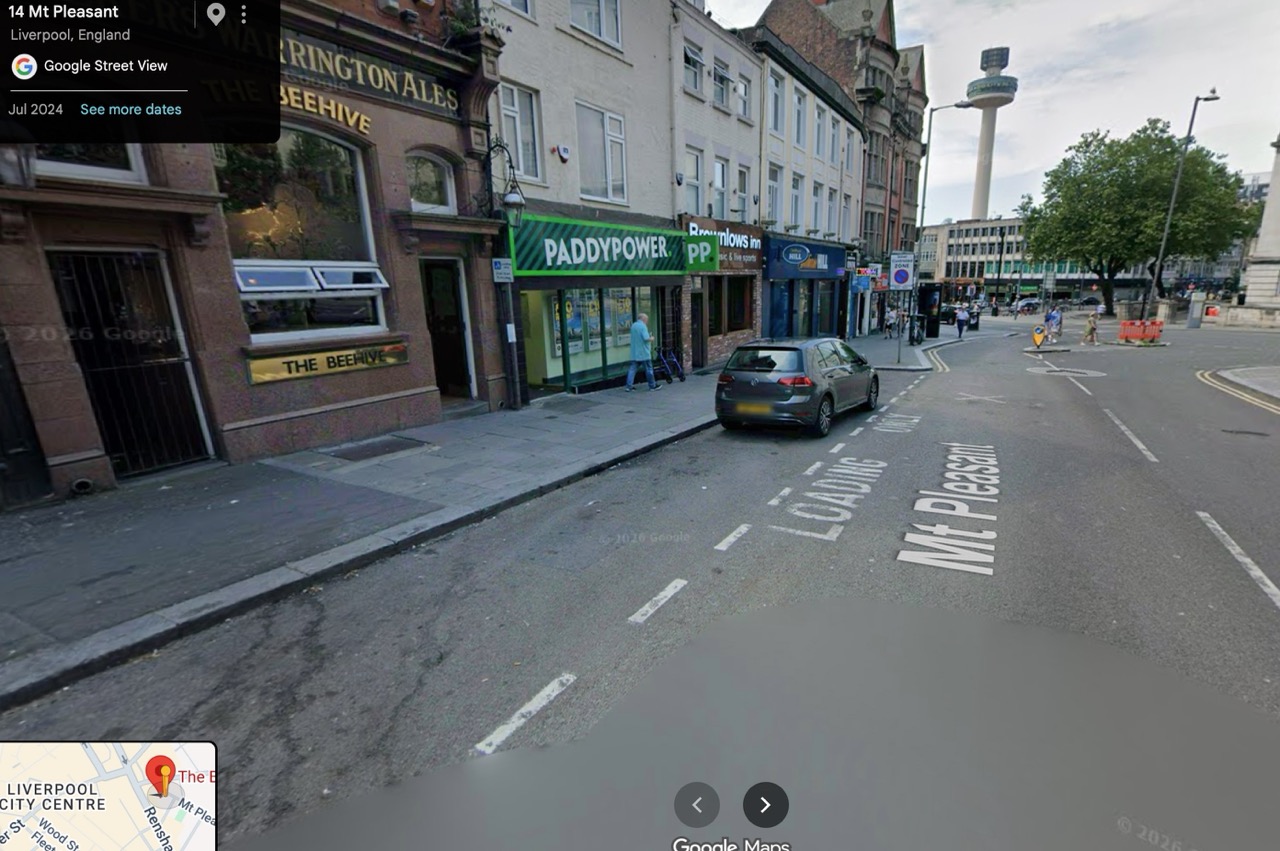 GSV image above is clickable.Should this be appealed and, if so, on what basis?
-
#7 Re: Camden. Code 52M Failing to comply with a prohibition. Belsize Lane NW3
on 03 Jun, 2026 17:52 in Civil penalty charge notices (Councils, TFL and so on)
A response, finally:QuotePenalty Charge Notice: CU74691635Location: BELSZE LANE NW3Date: 24/04/2026 at 09:06Vehicle: MH65RTZ[Name and address redacted]29 May 2026Dear Mr XXXXXNOTICE OF REJECTION OF REPRESENTATIONS AGAINST PENALTY CHARGE NOTICE- The London Local Authorities Acts 1990 - 2003Verification code: 71E611Contravention code: 52MFailing to comply with a prohibition on certain types of vehicle (no motor vehicles)Thank you for your representations received on 19/05/2026 regarding the above Penalty Charge Notice (PCN). Following my investigation I have decided to formally reject your representations for the reasons detailed below.Firstly, please accept my apologies for the delay in responding to your query and any inconvenience this may have caused. Although we endeavour to respond to all enquiries within our targeted time frame of 10 working days, in this instance it has not been possible.The enforcement camera recorded your vehicle in Belsize Lane in contravention of the prohibition on certain types of vehicles. This footage has been reviewed by a Civil Enforcement Officer who has confirmed your vehicle was in contravention of the restriction.You have stated that the penalty charge exceeded the amount applicable in the circumstances of the case and does not comply with section 4(8)(a)(v) of the London Local Authorities and Transport for London Act 2003, however, this does not provide an exemption or sufficient mitigation to cancel the PCN.The Council does not accept that the PCN is invalid. The PCN must be read as a whole. It correctly states that the penalty charge must be paid before the end of the period of 28 days beginning with the date of the Notice. It also correctly states that if the penalty charge is paid before the end of the period of 14 days beginning with the date of the Notice, the amount of the penalty charge will be reduced by 50%.The later reference to 28 days beginning with the date of service appears in the part of the PCN dealing with the making of representations and the possible issue of a Charge Certificate. This is consistent with Schedule 1 to the 2003 Act. Schedule 1 paragraph 1(3) provides that the enforcing authority may disregard representations received after the end of 28 days beginning with the date on which the PCN was served. Schedule 1 paragraph 5 further provides that, where no representations are made, the relevant period for service of a Charge Certificate is 28 days beginning with the date on which the PCN was served.The Council therefore does not accept that the PCN conflates or misstates the statutory scheme. Rather, the PCN sets out the payment period by reference to the date of the Notice, and separately explains the representation and escalation position by reference to the date of service. The reference to date of service does not reduce the period available to the recipient. If anything, it provides additional protection to the recipient, particularly where a postal notice is received after the date printed on the notice.The Council has also noted the adjudication decisions referred to in your representations. Those decisions are not binding on the Council or another adjudicator, and each case must be considered on its own facts and on the wording of the PCN in question. The Council is satisfied that this PCN, read fairly and as a whole, substantially complies with the requirements of the 2003 Act.The Council is therefore not satisfied that the penalty charge exceeded the amount applicable in the circumstances of the case.In relation to this PCN, I have reviewed the CCTV footage which shows your vehicle proceeding past duplicate signage informing drivers of the prohibition on certain types of vehicles. These signs notify drivers that motor vehicles are not allowed to enter Belsize Lane Monday to Friday 8am-9:15am and 3pm-4pm during school term time and I am satisfied that the signs are sufficiently clear to inform motorists of the restrictions in place and these signs are fully compliant with the Traffic Signs Regulations and General Directions 2016. As your vehicle entered the street where the prohibition was in force, a contravention occurred and I am enforcing this PCN.Certain streets within Camden are restricted to specific types of vehicles, some or all of the time. This is to reduce traffic flow near schools or nurseries and deter drivers from using short cuts through residential areas.I have included CCTV images below for your reference and enclosed a photograph of the signage at the location. You may also view video footage of the incident online at camden.gov.uk/pcn.I have considered the comments that you have made in accordance with the requirements of schedule 1 of the London Local Authorities Act 1990 - 2003 and for the reasons outlined above I am satisfied that a contravention occurred. We will accept the discount rate of £80.00 if received within 14 days from the date of this letter. After this period the charge will revert to £160.00 and this amount will apply to any further correspondence or an appeal to the Environment and Traffic Adjudicators.Yada, yada...Camden’s rejection is more or less as predicted, as it does not really answer the statutory point. It mainly asserts “read as a whole” and “substantial compliance”.Their rejection appears to have three weaknesses.First, they wrongly characterise the point as if it were asking for “an exemption or sufficient mitigation”. It is neither. It is a statutory validity argument. The point is that the PCN failed to include mandatory information required by section 4(8)(a)(v).Second, they accept the PCN must be read as a whole, but then avoid the core issue. Section 4(8)(a)(v) requires the PCN to state that if the penalty is not paid before the end of “the 28 day period”, an increased charge may be payable. “The 28 day period” refers back to section 4(8)(a)(iii), namely 28 days beginning with the date of the notice. Camden’s PCN does not state that. Their response says the payment period is correctly stated elsewhere, but that is not the same as stating the mandatory section 4(8)(a)(v) warning.Third, Camden’s reliance on Schedule 1 is the argument as expected, but it is not a complete answer. Schedule 1 explains when a Charge Certificate may be served. Section 4(8) prescribes what the PCN itself must state. Camden are effectively saying that because their later enforcement wording is consistent with Schedule 1, it does not matter that the mandatory wording required by section 4(8)(a)(v) is absent or misstated. That should be the issue for the adjudicator.I will ask the Keeper whether they are prepared to risk the additional £80. Chalko gives this point a real chance. Barnet gives the broader High Court principle. I understand that it is still not guaranteed, because the adjudicator may accept Camden’s “read as a whole/substantial compliance” argument.How does this sound for the London Tribunals appeal:QuoteAppeal against Notice of RejectionPCN CU74691635Ground: The penalty charge exceeded the amount applicable in the circumstances of the caseI appeal on the ground that the penalty charge exceeded the amount applicable in the circumstances of the case.This is not a mitigation appeal. It is a statutory validity appeal. The PCN fails to comply with section 4(8)(a)(v) of the London Local Authorities and Transport for London Act 2003.Section 4(8)(a)(iii) requires the PCN to state that the penalty charge must be paid before the end of the period of 28 days beginning with the date of the notice. Section 4(8)(a)(v) then requires the PCN to state that, if the penalty charge is not paid before the end of “the 28 day period”, an increased charge may be payable.The reference to “the 28 day period” plainly refers back to the 28-day period identified in section 4(8)(a)(iii), namely the period of 28 days beginning with the date of the notice.The Camden PCN does not state that mandatory information. Instead, it states:“If you fail to pay the Penalty Charge or make representations before the end of a period of 28 days beginning with the date of service of this notice an increased charge of £240 may be payable…”That is materially different. It substitutes “date of service” for “date of the notice” and conflates the payment period with the separate period for making representations. The PCN therefore fails to state the mandatory information required by section 4(8)(a)(v).The Council’s Notice of Rejection does not cure the defect. It says the PCN should be read as a whole and that the reference to 28 days beginning with date of service is consistent with Schedule 1. That misses the point. Schedule 1 deals with when a Charge Certificate may be served. Section 4(8) deals with what the PCN itself must state. Compliance with one provision does not excuse non-compliance with the other.The Council also states that the date-of-service wording gives additional protection to the recipient. Again, that is not the statutory test. The issue is not whether the recipient was given a longer practical period before escalation. The issue is whether the PCN stated the mandatory information required by section 4(8)(a)(v). It did not.I rely on Joanna Chalko v London Borough of Havering, case reference 2250426286. In that case, the adjudicator allowed an appeal on the same section 4(8)(a)(v) point, finding that the difference between “date of the notice” and “date of service” could lead to miscalculation of the relevant period and that the collateral challenge succeeded.I also rely on R (London Borough of Barnet) v The Parking Adjudicator [2006] EWHC 2357 (Admin). Although that case concerned an earlier statutory regime, the principle is directly applicable. Where the statutory scheme prescribes mandatory PCN content, compliance is required. The High Court rejected the argument that absence of prejudice could cure non-compliance.The Council says the tribunal decisions relied on are not binding. I accept that London Tribunals decisions are not binding on another adjudicator. However, Chalko is directly persuasive because it concerns the same statutory provision and the same date-of-notice/date-of-service defect. Barnet is High Court authority and supports the proposition that mandatory statutory requirements cannot simply be disregarded on a “no prejudice” or “substantial compliance” basis.Accordingly, the PCN was not compliant with section 4(8) of the 2003 Act. No valid penalty charge was lawfully demanded. The penalty charge therefore exceeded the amount applicable in the circumstances of the case and the appeal should be allowed.Any views from the experts? -
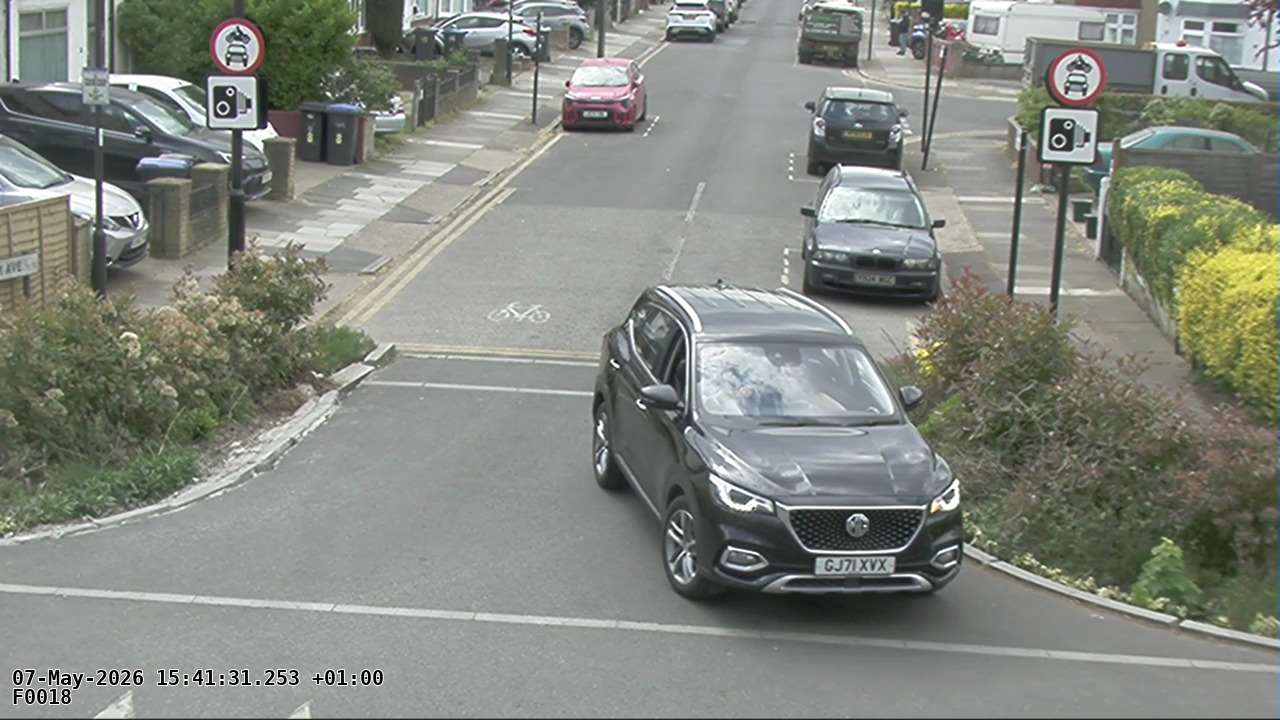
#8 Enfield. Code 52M Failure to comply with the prohibition of motor vehicles. AMERSHAM AVENUE N18 (x 2)
on 16 May, 2026 20:50 in Civil penalty charge notices (Councils, TFL and so on)
The driver was using a relatives car. They are not from London and were in the area looking for somewhere to park after dropping their daughter off at hospital. Obviously not observant enough. Two PCNs for same contravention on same day.Is this worth making representations on?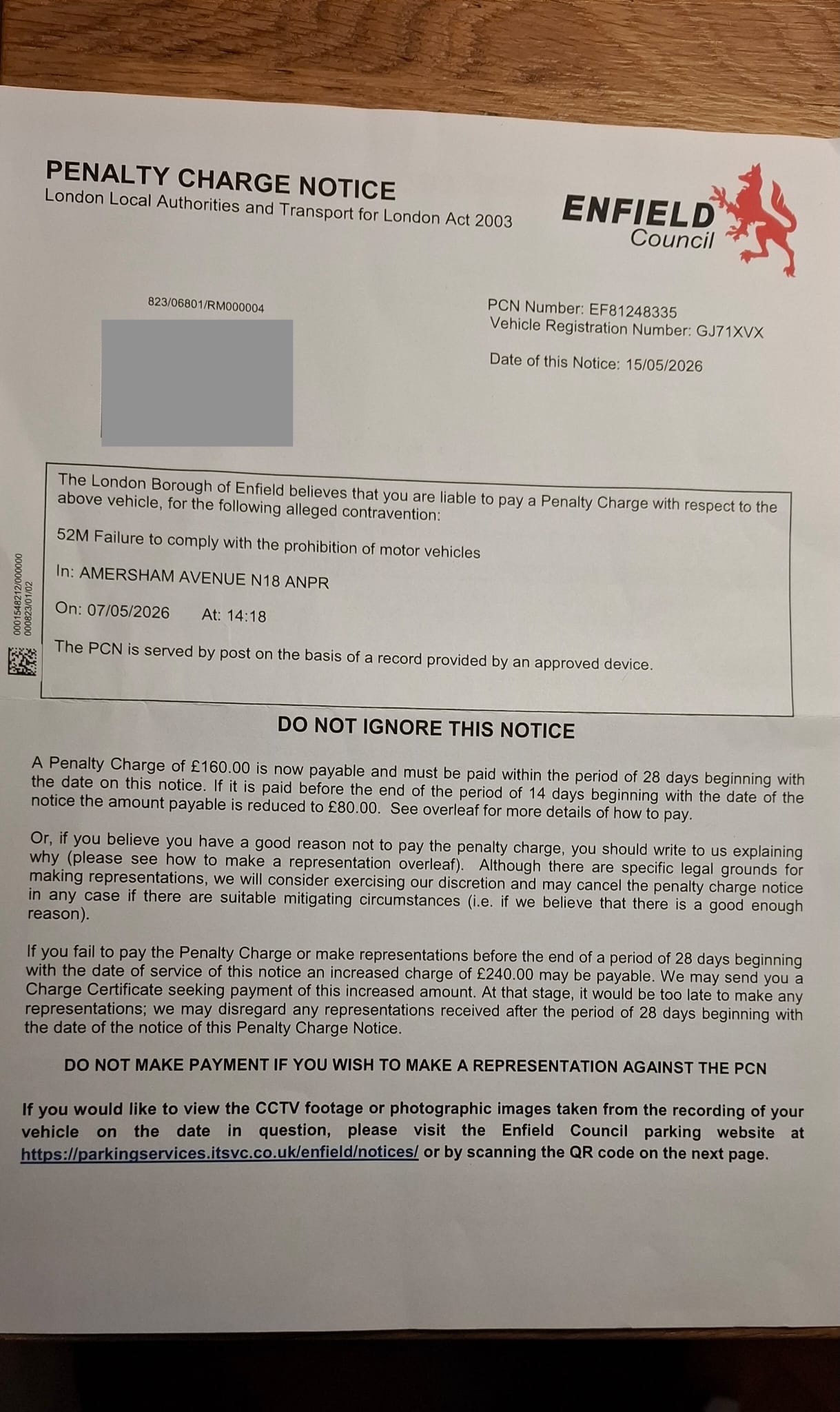
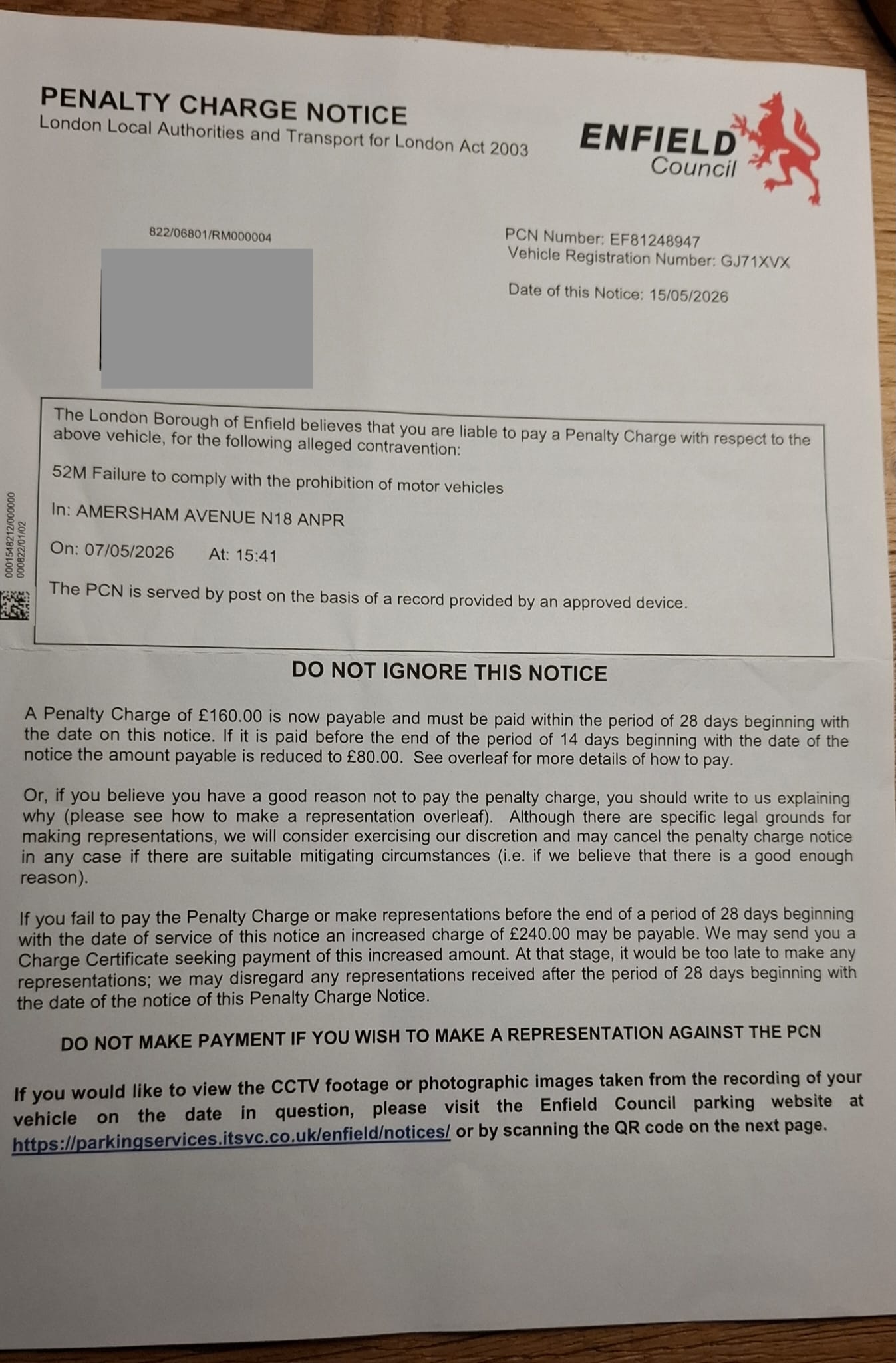
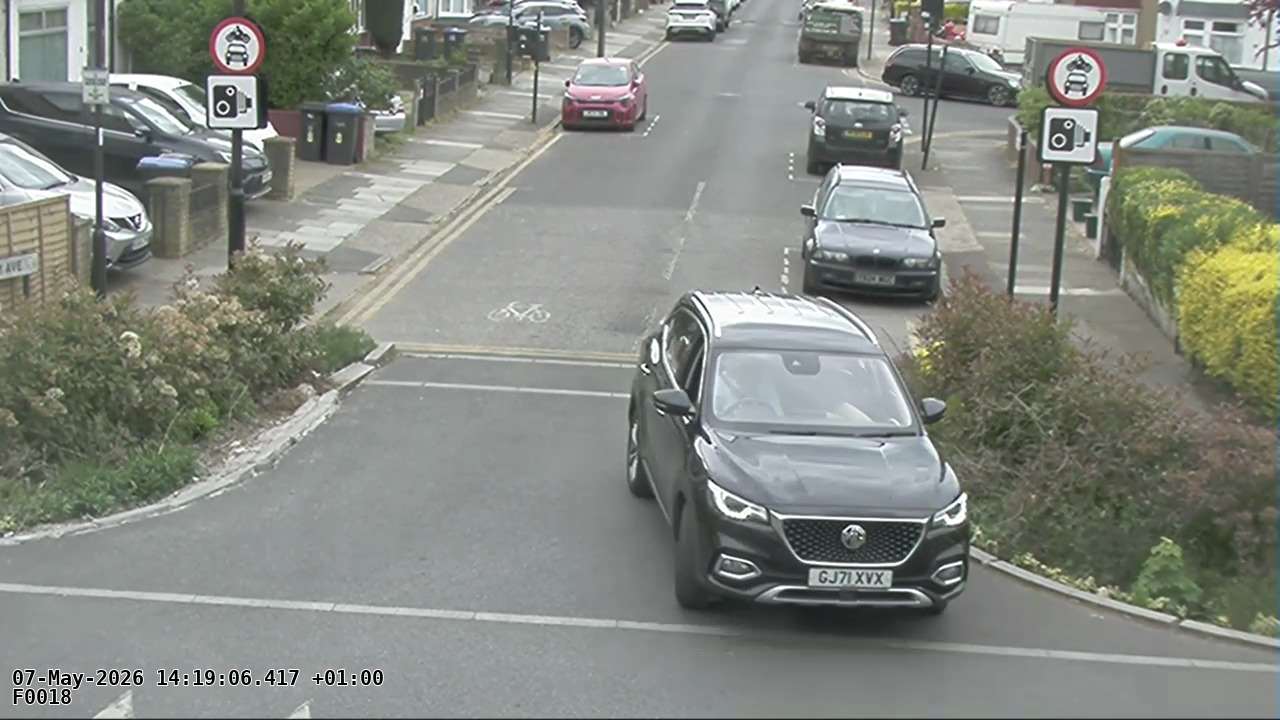
-
#9 Enfield. Code 33C Using a route restricted to certain vehicles (Buses & Cycles only). BULL LANE N18 BUS GATE
on 16 May, 2026 20:27 in Civil penalty charge notices (Councils, TFL and so on)
The driver was using a relatives car. They are not from London and were in the area looking for somewhere to park after dropping their daughter off at hospital. Obviously not observant enough.Is this worth making representations on?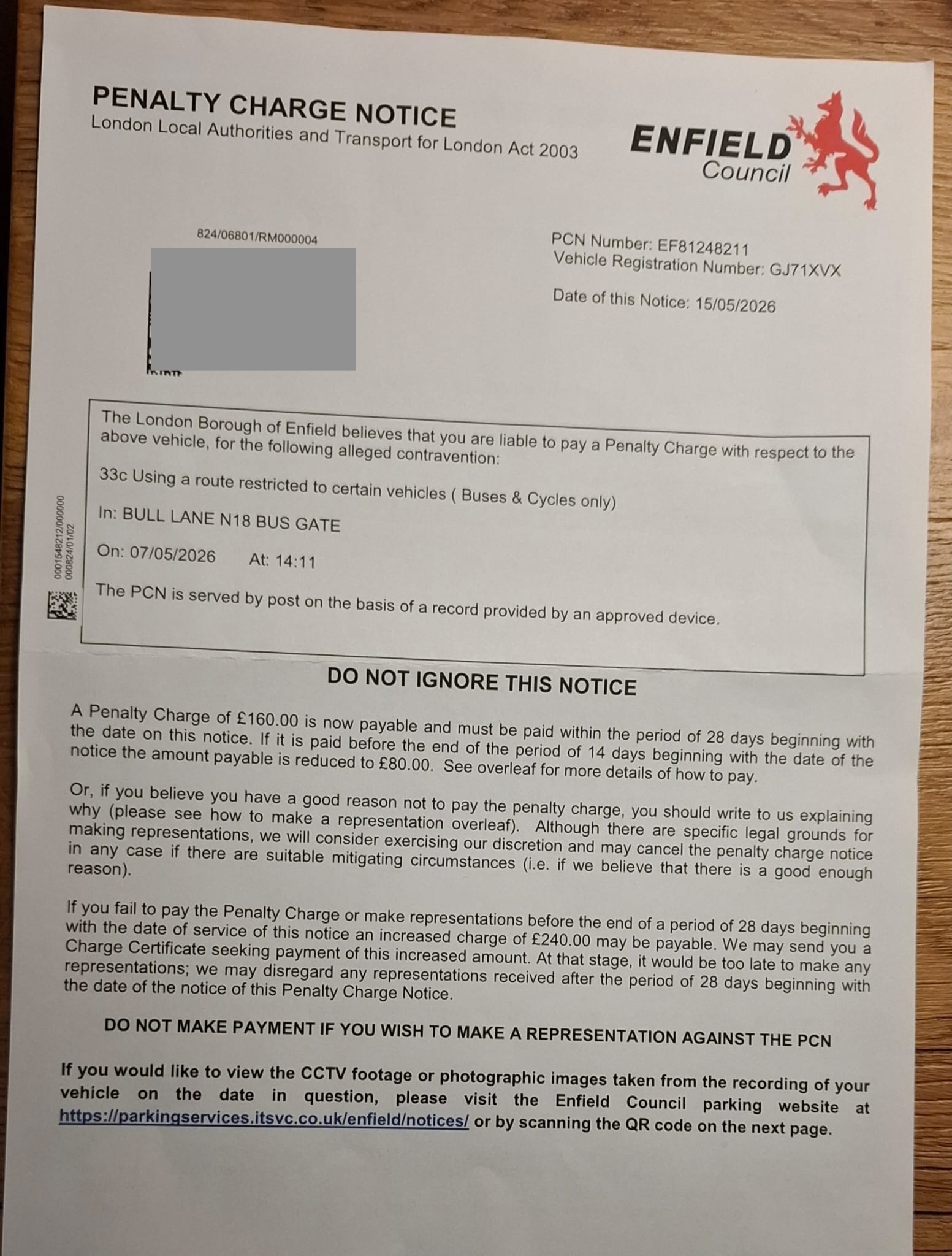
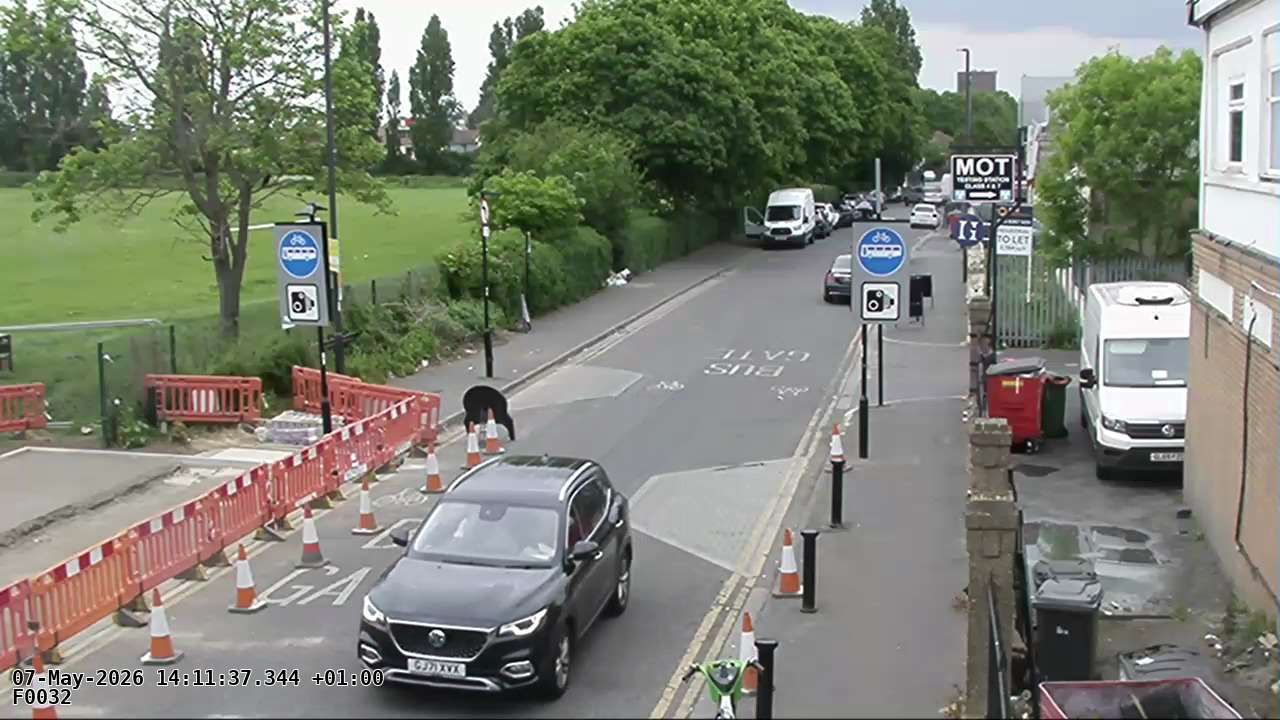 https://cdn.imgpile.com/f/9iG9gjX.mp4
-
#10 Re: Camden. Code 52M Failing to comply with a prohibition. Belsize Lane NW3
on 04 May, 2026 18:58 in Civil penalty charge notices (Councils, TFL and so on)
Thanks for that. I did eventually find a reference to that fact and have submitted a challenge as follows:QuoteFull Representations in Support of Statutory ChallengePCN: CU74691635Vehicle Registration: MH65RTZGround relied upon: The penalty charge exceeded the amount applicable in the circumstances of the caseThese full representations are uploaded in support of the online representation submitted through Camden’s portal. They are to be treated as part of the formal representations against the above PCN.The challenge is made on the statutory ground that the penalty charge exceeded the amount applicable in the circumstances of the case.The PCN is invalid because it fails to comply with section 4(8)(a)(v) of the London Local Authorities and Transport for London Act 2003.Section 4(8)(a)(iii) requires the PCN to state that the penalty charge must be paid before the end of the period of 28 days beginning with the date of the notice. Section 4(8)(a)(v) then requires the PCN to state that, if the penalty charge is not paid before the end of “the 28 day period”, an increased charge may be payable.The phrase “the 28 day period” plainly refers back to the 28-day period identified in section 4(8)(a)(iii), namely 28 days beginning with the date of the notice.This PCN does not state that mandatory information. Instead, it states:“If you fail to pay the Penalty Charge or make representations before the end of a period of 28 days beginning with the date of service of this notice an increased charge of £240 may be payable…”That is materially different. It substitutes the date of service for the date of the notice. It also conflates the statutory payment period with the separate period for making representations. The PCN therefore fails to state the mandatory information required by section 4(8)(a)(v).This is not merely a harmless drafting variation. In Joanna Chalko v London Borough of Havering, case reference 2250426286, the adjudicator allowed an appeal on the same section 4(8)(a)(v) point, expressly finding that the difference between date of notice and date of service could lead to miscalculation of the relevant period and that the collateral challenge succeeded.I also rely on R (London Borough of Barnet) v The Parking Adjudicator [2006] EWHC 2357 (Admin). Although that case concerned the earlier parking enforcement regime, the principle is directly relevant. Where the statute prescribes mandatory PCN content, compliance is required. The High Court rejected the argument that absence of prejudice could cure non-compliance. If the statutory conditions are not met, financial liability does not arise.Further, in Eleanor Macwhinnie v London Borough of Hounslow, case reference 2250221909, the adjudicator accepted that defective Charge Certificate wording was material where it could influence the motorist’s decision whether to challenge the PCN. That reinforces the point that the statutory warning must accurately convey the consequences of payment, representations and escalation.The rear of Camden’s PCN does not cure the defect. It sets out payment methods and representation grounds, but it does not provide the missing mandatory section 4(8)(a)(v) information.Accordingly, the PCN does not comply with the mandatory requirements of the 2003 Act. No valid penalty charge was lawfully demanded. The penalty charge therefore exceeded the amount applicable in the circumstances of the case and the PCN must be cancelled.I also uploaded the 3 transcripts mentioned in the challenge. Let's see what they come back with. -
#11 Re: Camden. Code 52M Failing to comply with a prohibition. Belsize Lane NW3
on 04 May, 2026 17:28 in Civil penalty charge notices (Councils, TFL and so on)
One additional question... If the representation is made within the discount period (14 days) and is unsuccessful, do they re-offer the payment at the discounted rate or is that lost because a representation is made? -
#12 Re: Camden. Code 52M Failing to comply with a prohibition. Belsize Lane NW3
on 04 May, 2026 02:13 in Civil penalty charge notices (Councils, TFL and so on)
Thank you @Hippocrates. So, would the following be good enough for representation by the Keeper?QuoteThe PCN does not comply with section 4(8)(a)(v) of the London Local Authorities and Transport for London Act 2003.Section 4(8)(a)(iii) requires the PCN to state that the penalty charge must be paid before the end of the period of 28 days beginning with the date of the notice. Section 4(8)(a)(v) then requires the PCN to state that, if the penalty charge is not paid before the end of “the 28 day period”, an increased charge may be payable. The reference to “the 28 day period” is plainly a reference back to the 28-day period beginning with the date of the notice.This PCN does not state that. It states instead:“If you fail to pay the Penalty Charge or make representations before the end of a period of 28 days beginning with the date of service of this notice an increased charge of £240 may be payable…”That is materially different. It substitutes the date of service for the date of the notice and conflates the payment period with the period for making representations. The statutory warning required by section 4(8)(a)(v) is therefore absent or, at the very least, misstated. The PCN does not accurately convey the mandatory statutory information and is therefore invalid.Based on your experience, how likely would you think that an adjudicator may still try to dispose of it on substantial compliance or lack of prejudice grounds, especially if they read the PCN as a whole and treat the Schedule 1 wording as sufficiently informative? -
#13 Re: Camden. Code 52M Failing to comply with a prohibition. Belsize Lane NW3
on 03 May, 2026 12:21 in Civil penalty charge notices (Councils, TFL and so on)
I appreciate that the driver should not trust their sat-nav blindly and they have already been admonished for that error. I will tell the driver to wait and see if there are any technical appeal points but, if none points out any by the discount deadline, I will advise them to pay it at the discounted rate by then. -
#14 Re: Camden. Code 52M Failing to comply with a prohibition. Belsize Lane NW3
on 03 May, 2026 11:09 in Civil penalty charge notices (Councils, TFL and so on)
The driver was travelling SW to NE long Belsize Lane and was turning left to continue on Belsize Lane at the junction with Ornan Rd.The driver had just started their drive from about 200m further back. They were following their sat-nav. The driver does not remember seeing a sign on the left as they turned in but according to the latest GSV view there does appear to be sign on the left hand side.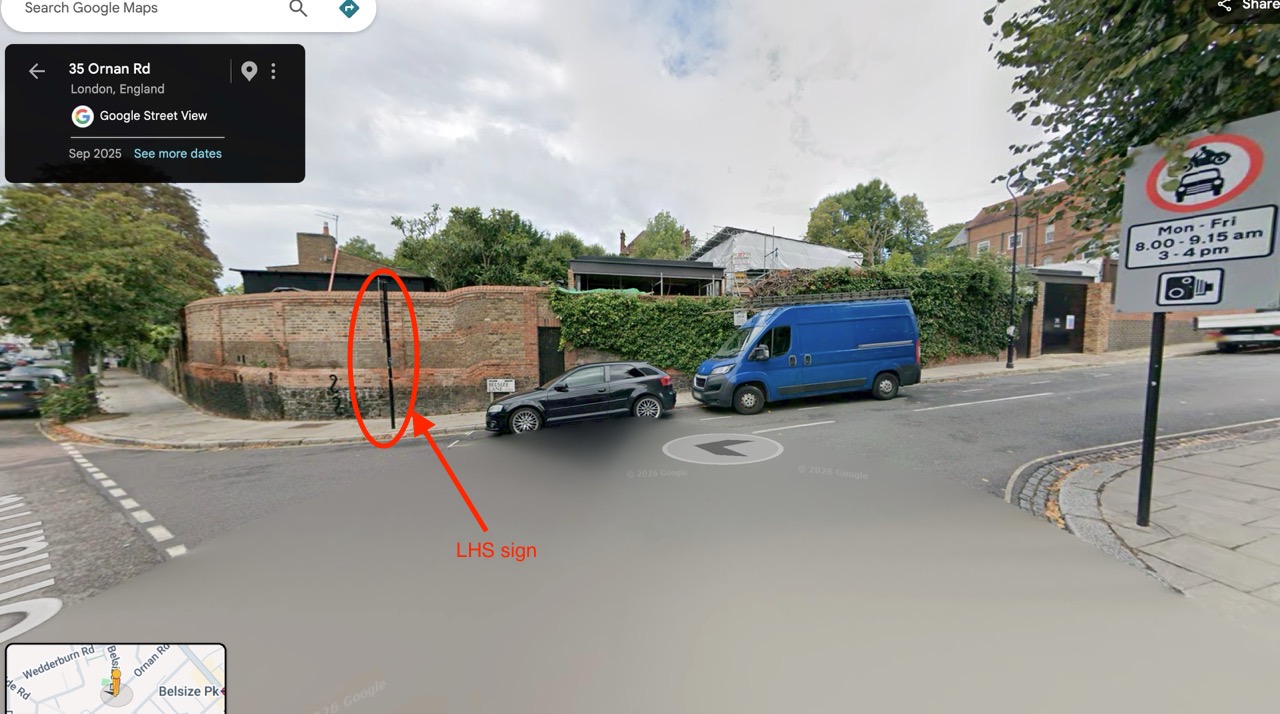 This is the evidential video:Video
-
#15 Re: Camden. Code 52M Failing to comply with a prohibition. Belsize Lane NW3
on 03 May, 2026 06:07 in Civil penalty charge notices (Councils, TFL and so on)
Thanks. The GSV image (2nd image) is also a link to the view location.https://maps.app.goo.gl/fqtoYfGpdWZ2TWw26