Show Posts

This section allows you to view all posts made by this member. Note that you can only see posts made in areas you currently have access to.

Messages - neverpaying

Pages: [1] 2 3 ... 5
1
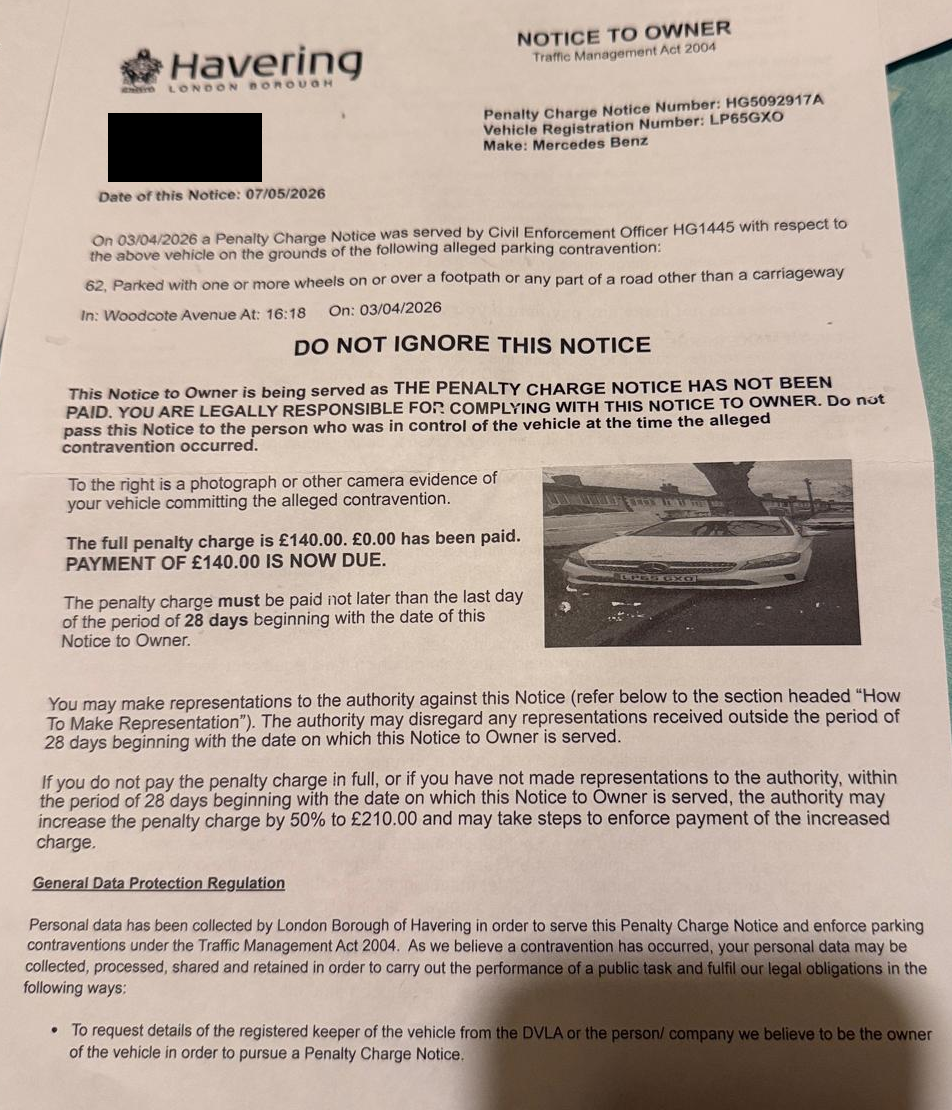
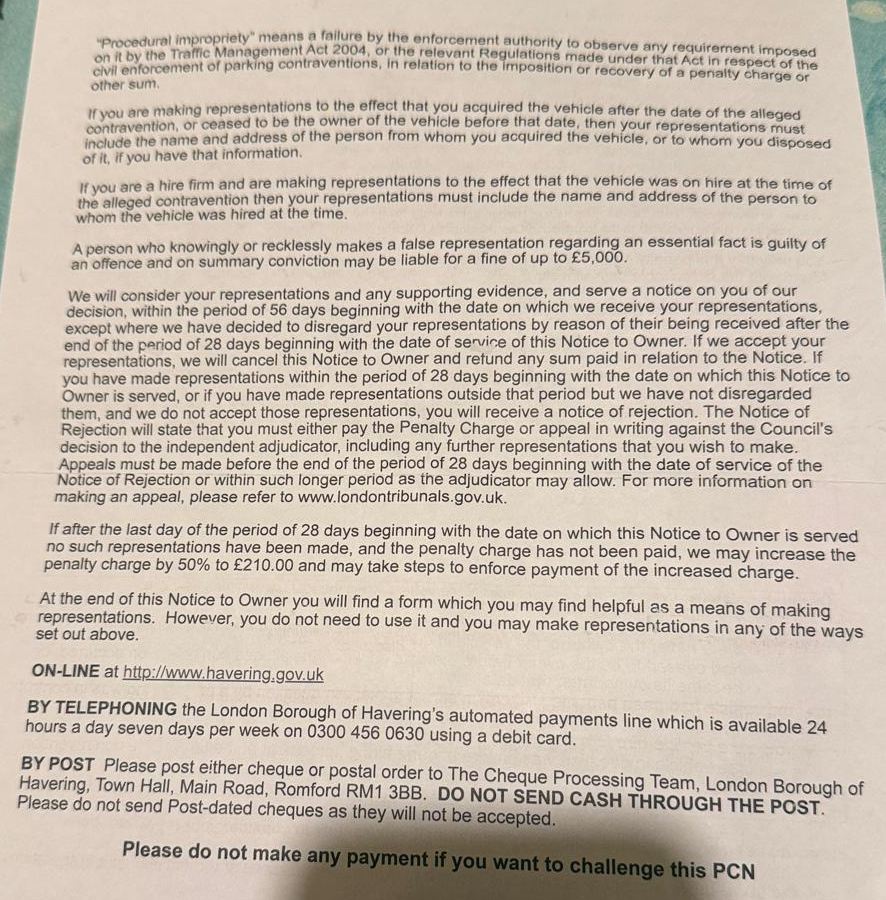
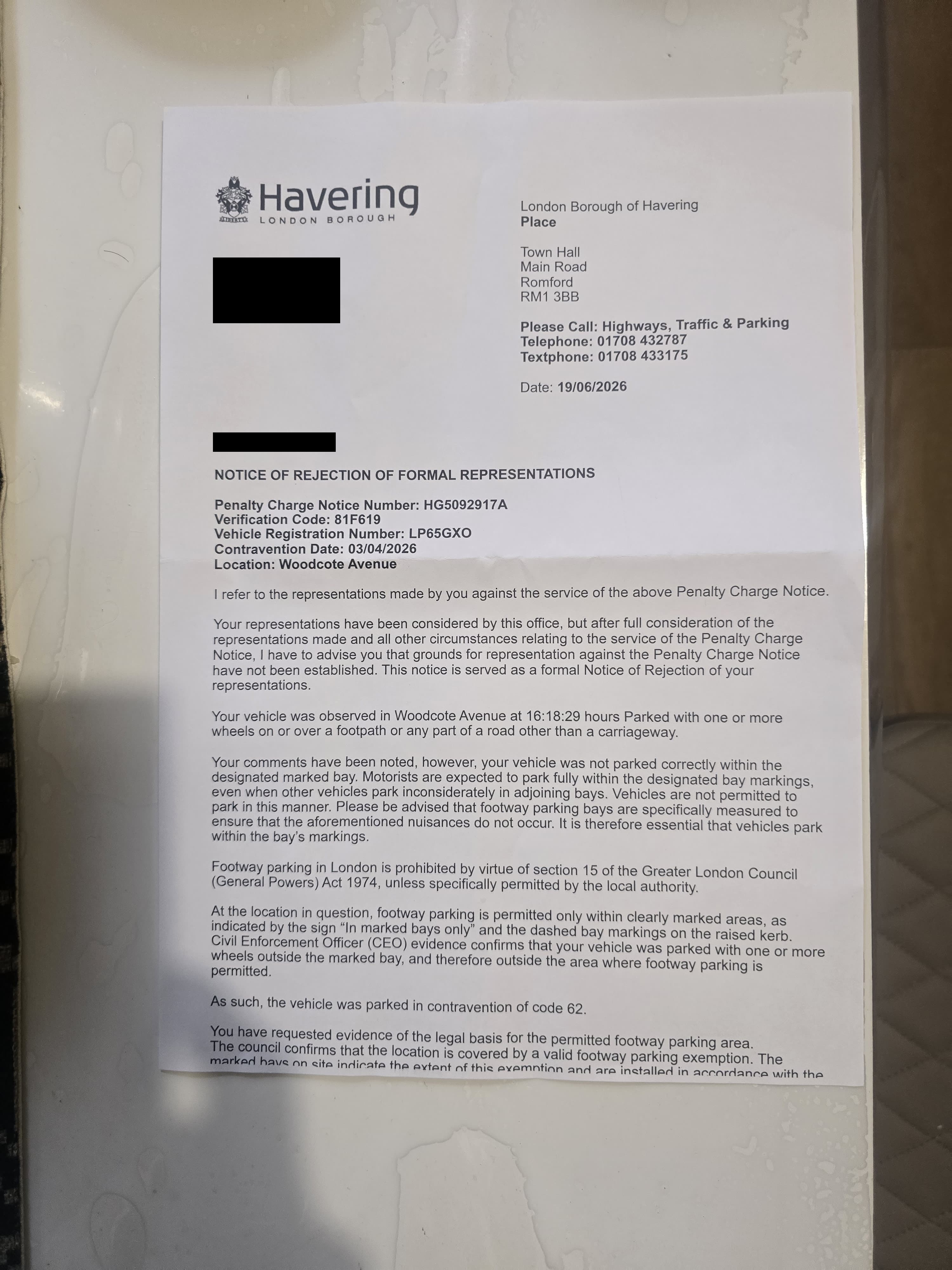
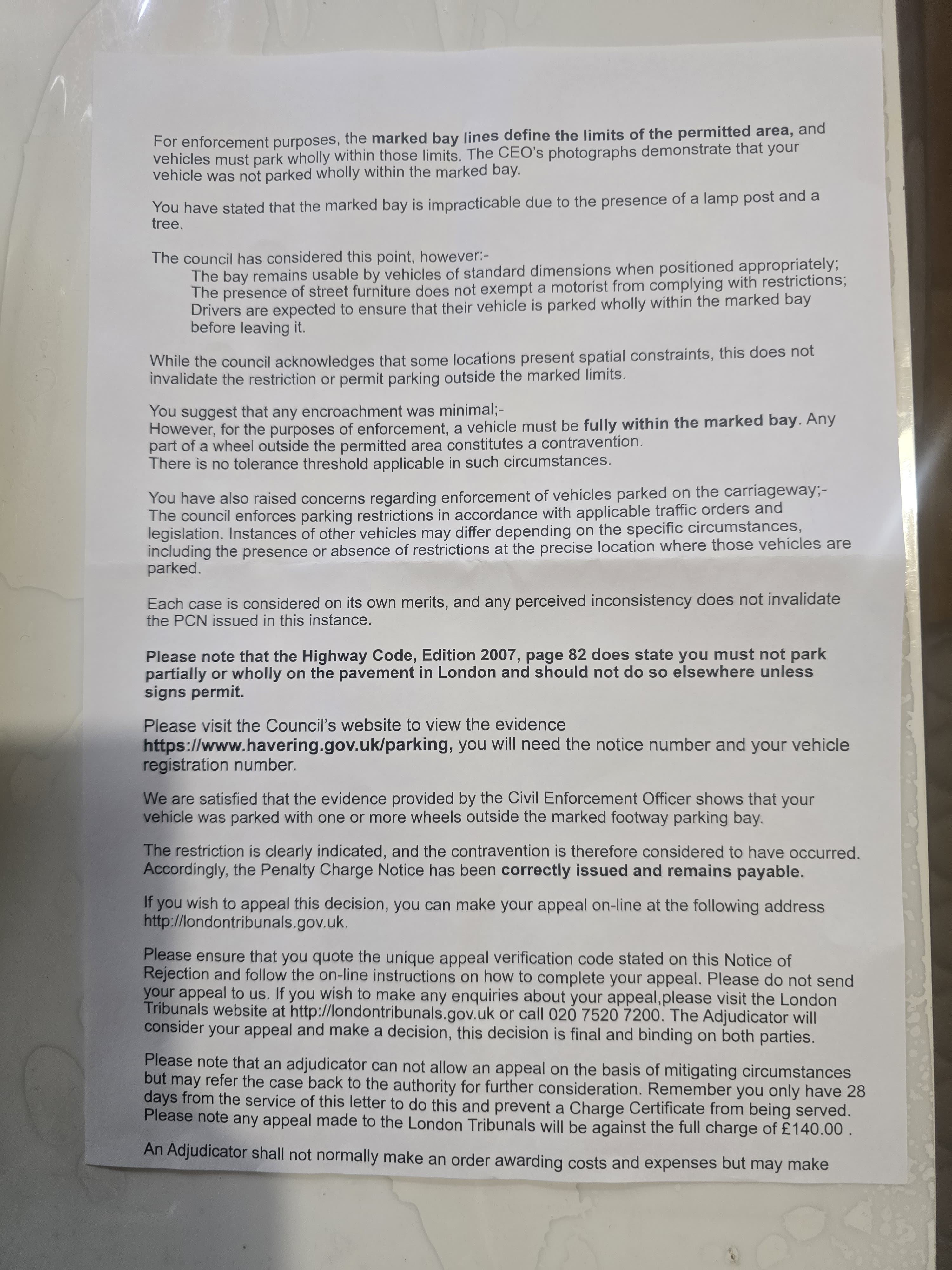
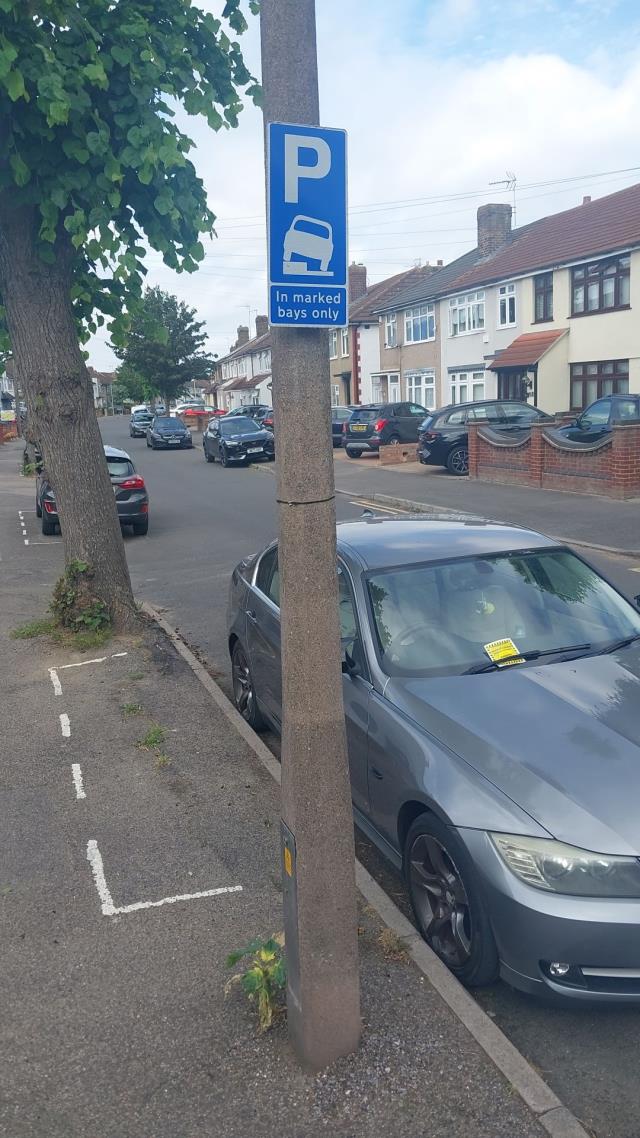
And here's the photos of the NoR


2
Here are the photos of the NTO:


3
NoR received 19/06

> I refer to the representations made by you against the service of the above Penalty Charge Notice.

Your representations have been considered by this office, but after full consideration of the representations made and all other circumstances relating to the service of the Penalty Charge Notice, I have to advise you that grounds for representation against the Penalty Charge Notice have not been established. This notice is served as a formal Notice of Rejection of your representations.

Your vehicle was observed in Woodcote Avenue at 16:18:29 hours Parked with one or more wheels on or over a footpath or any part of a road other than a carriageway.

Your comments have been noted, however, your vehicle was not parked correctly within the designated marked bay. Motorists are expected to park fully within the designated bay markings, even when other vehicles park inconsiderately in adjoining bays. Vehicles are not permitted to park in this manner. Please be advised that footway parking bays are specifically measured to ensure that the aforementioned nuisances do not occur. It is therefore essential that vehicles park within the bay’s markings.

Footway parking in London is prohibited by virtue of section 15 of the Greater London Council (General Powers) Act 1974, unless specifically permitted by the local authority.

At the location in question, footway parking is permitted only within clearly marked areas, as indicated by the sign “In marked bays only” and the dashed bay markings on the raised kerb. Civil Enforcement Officer (CEO) evidence confirms that your vehicle was parked with one or more wheels outside the marked bay, and therefore outside the area where footway parking is permitted.

As such, the vehicle was parked in contravention of code 62.

You have requested evidence of the legal basis for the permitted footway parking area.
The council confirms that the location is covered by a valid footway parking exemption. The marked bays on site indicate the extent of this exemption and are installed in accordance with the [cut off]

For enforcement purposes, the marked bay lines define the limits of the permitted area, and vehicles must park wholly within those limits. The CEO’s photographs demonstrate that your vehicle was not parked wholly within the marked bay.

You have stated that the marked bay is impracticable due to the presence of a lamp post and a tree.

The council has considered this point, however:-

The bay remains usable by vehicles of standard dimensions when positioned appropriately;
The presence of street furniture does not exempt a motorist from complying with restrictions;
Drivers are expected to ensure that their vehicle is parked wholly within the marked bay before leaving it.

While the council acknowledges that some locations present spatial constraints, this does not invalidate the restriction or permit parking outside the marked limits.

You suggest that any encroachment was minimal:-

However, for the purposes of enforcement, a vehicle must be fully within the marked bay. Any part of a wheel outside the permitted area constitutes a contravention.
There is no tolerance threshold applicable in such circumstances.

You have also raised concerns regarding enforcement of vehicles parked on the carriageway:-

The council enforces parking restrictions in accordance with applicable traffic orders and legislation. Instances of other vehicles may differ depending on the specific circumstances, including the presence or absence of restrictions at the precise location where those vehicles are parked.

Each case is considered on its own merits, and any perceived inconsistency does not invalidate the PCN issued in this instance.

Please note that the Highway Code, Edition 2007, page 82 does state you must not park partially or wholly on the pavement in London and should not do so elsewhere unless signs permit.

[...]

Unless you appeal to the London Tribunals as described above, you must pay the Penalty Charge Notice of £140.00 within 28 days from the service of this letter. Failure to pay may result in the service of a Charge Certificate by the Council which will increase the charge due by 50% to £210.00. If the increased Penalty Charge is not then paid within a further 14 days, the Council may apply to the County Court to recover the charge as if it were a debt payable under a County Court Order.

4
Appeal sent on 04/06

I make formal representations against the Notice to Owner for contravention code 62: “parked with one or more wheels on or over a footpath or any part of a road other than the carriageway.”
The location is subject to a sign stating “In marked bays only”, with dashed bay markings on the carriageway/raised kerb. I do not dispute that there is signage at the location. However, I do dispute that the authority has proved that the alleged position of the vehicle amounted to a contravention.

A) The authority must prove the legal extent of the permitted footway-parking area:
Footway parking in London is prohibited by default unless the authority has created a lawful exemption for the relevant location. Where the council relies on a sign and bay markings to say that footway parking is permitted only within a specific marked area, the council must prove that the marked area corresponds with the legal exemption.
A sign and dashed line do not, by themselves, prove the legal boundary of the exemption. I therefore require the council to produce the relevant footway-parking resolution, authorisation, plan, schedule, or other legal document showing:
a. that footway parking is lawfully permitted at this exact location;
b. the precise extent of the permitted area;
c. that the dashed bay markings relied on by the CEO are the legal boundary of that permitted area; and
d. that the alleged wheel position was outside that legally permitted area, not merely alleged to be outside a painted line.
If the council cannot produce this evidence, it has not proved that the alleged contravention occurred.

B) The marked bay is physically impracticable because of fixed street furniture:
The marked bay at this location is constrained by fixed street furniture, specifically a lamp post and a tree. The available space between them is extremely limited. The layout makes it difficult for a vehicle to use the raised-kerb bay while remaining perfectly aligned within the dashed markings.
The alleged issue was, at most, a marginal wheel position caused by the impractical layout of the bay. This was not a case of a vehicle deliberately parking on the footway outside any permitted area. The council has created and maintained a marked footway-parking bay in a position where ordinary use is made difficult by fixed obstructions.
If the council rejects these representations, it is requested to address this point specifically and explain how a motorist is expected to comply with the bay markings at this exact location, given the positioning of the lamp post and tree. The council should also provide the CEO photographs and any site photographs it relies upon to show that the vehicle was materially outside the permitted area.

C) Inconsistent enforcement at this location creates uncertainty:
I am also concerned that the council’s enforcement position at this location appears inconsistent. The sign directs motorists to use the marked raised-kerb bays only. However, it has been observed, on more than one occasion, that vehicles parked fully on the carriageway, where there appears to be no separate waiting restriction, have also received PCNs.
This creates obvious uncertainty for motorists. On the one hand, motorists are directed towards a physically constrained raised-kerb bay. On the other hand, parking fully on the carriageway appears also to be treated as unlawful in practice, despite there being no clear carriageway restriction apparent at the location.
The council is therefore requested to check its own enforcement records and explain its enforcement policy at this location. In particular, the council should explain what lawful parking position it says was available to motorists at this location, and whether vehicles parked wholly on the carriageway are also subject to enforcement there.
This point is relevant because it supports my case that the parking arrangement is unclear, inconsistently enforced, and not adequately communicated to motorists.


Evidence requested if the council rejects these representations:
If the council is not prepared to cancel the PCN, I require it to provide the following with the Notice of Rejection:
a.   the relevant footway-parking resolution or authorisation;
b.   any plan, map, schedule, or drawing showing the exact legal boundary of the permitted footway-parking area;
c.   evidence that the dashed markings at this location correspond with that legal boundary;
d.   an explanation of how the council says a vehicle can reasonably use the marked bay given the lamp post and tree; and
e.   an explanation of the council’s enforcement approach to vehicles parked wholly on the carriageway at this location.
The council must consider these representations properly and address the substance of each point. A generic response stating only that footway parking is prohibited in London, or that the vehicle was outside markings, will not be adequate because the issue is whether the council has proved the legal boundary of the exemption and whether the marked bay is reasonably usable and clearly enforceable at this exact location.
For the reasons above, the alleged contravention has not been proved and the PCN should be cancelled.
5
Given my intention was to appeal, and that the discount is not re-offered, I've let the 14 day window lapse. I now have until 15/07 to send my representations.

I watched today as a CEO walked past a car parked on the carriageway in the exact same spot. I have also been told previously by a different CEO that the council policy is (correctly) to not give PCNs for it. So I am hopeful that the representation will be enough for Havering to recognise their mistake and cancel the PCN.

6
The council haven't even painted a compliant bay. A bay which is for parking partially on the footway must have 4 painted sides and if you are meant to be fully on the footway it needs 3 painted sides, the kerb stones marking the fourth


Thus there is no bay to be in breach of parking outside of.

Strap yourself in for the ride, you may have to challenge 3 times (one of which is at the tribunal).

Thank you, I will include that in my defence and will challenge as many times as needed if success is likely.

Earlier, it was said: "The footway bays apply only to exempt two-wheel up parking on the footway" -- is there an official reference for this statement? The TMO that I linked in the the first post doesn't explicitly mention it, is it implicitly understood because of something else?

7
Thank you both.

If the council were to defend by suggesting that I am "blocking" the parking space by improperly marking, would that have any merit? i.e. would my position have been stronger if my car had fit exactly within the projected bay lines? Or is that irrelevant

I will have to submit representations by end of day tomorrow

8
Hello all,

I've been served this PCN on my windshield for Code 24: "Not parked correctly within the markings of the bay or space"

From my understanding, which may be horribly flawed, I thought that in a two-wheels up parking space like this, those mounting the kerb need to remain within the marked bay and not overhang on to the footpath.

However, because this road isn't a controlled parking zone, i.e. there is no parking restriction otherwise on the road, shouldn't this mean that parking on the road is valid?

Here is the TMO: "Consolidation Order 2018 No. 110 and 2018 No. 111"

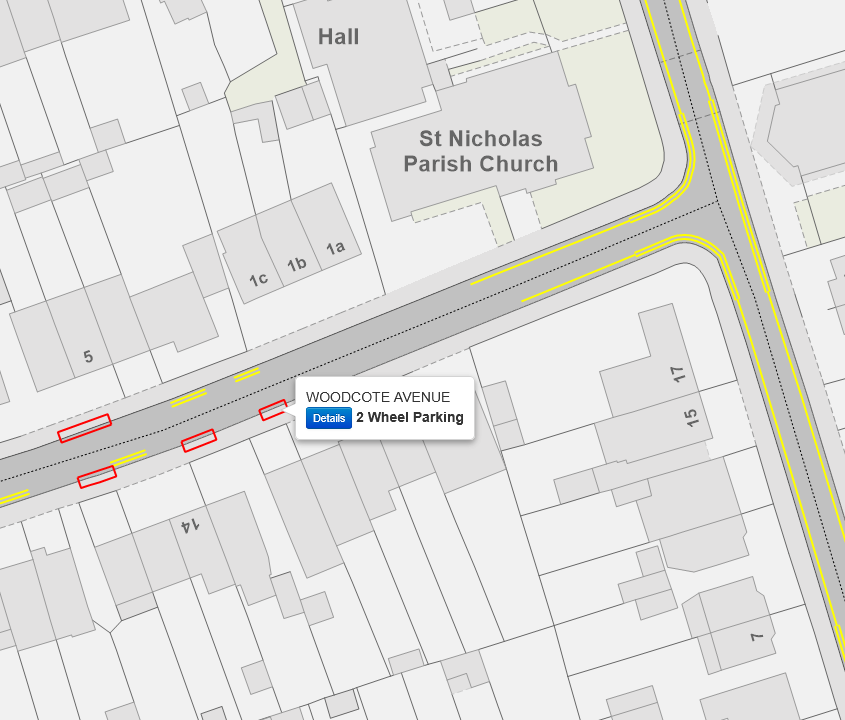
My defence may be undermined by me still existing within the "projected" boundaries of the parking space, as designated on this map below...


while also not fitting neatly within it...


Is this worth contesting? Havering include this unreasonably effective line that a discount is not re-offered if a challenge is unsuccessful: "If you are contesting the penalty, you will not be able to pay the discounted charge if your challenge is unsuccessful. This does not affect your statutory right to make a representation."

This is the same location as my other thread  :-X so I would be especially keen to find a flaw if one exists
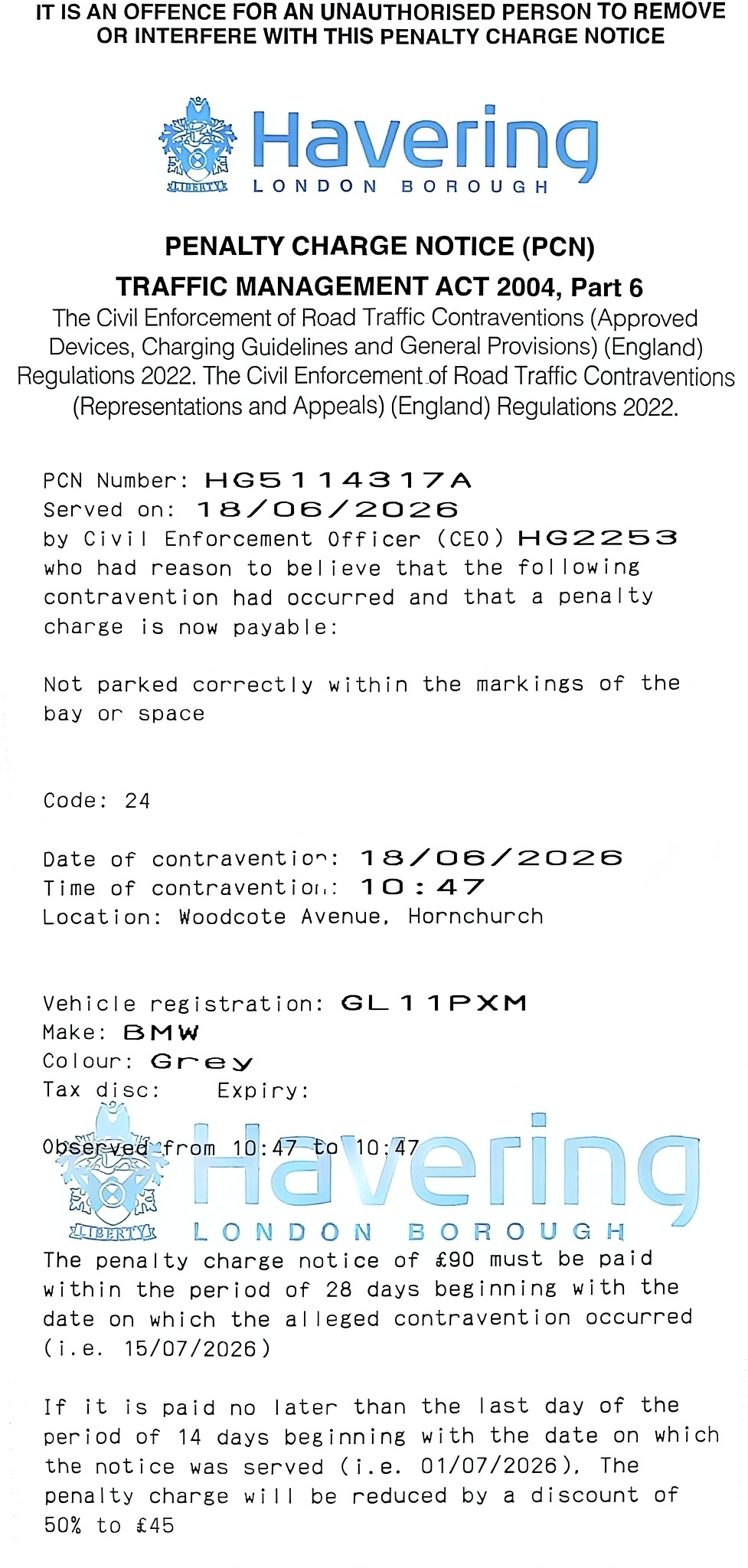
PCN:


9
This case from yesterday is indicative of the mess Newham makes of these TTOs.

-

Yes it seems, from reading the assessment, that the adjudicator would have accepted more than one of my points. Although, it was unexpected that she tried to read the TTO from the CEO's photographs even if it wasn't submitted under evidence. I also struggled to read it from that during the hearing.

Though I know it is not binding, it was also interesting to see that there was a valid concern in the time between the sign being erected and the penalty charge being issued.


Thank you to @tincombe and yourself for your help.

10
A very, very big mistake!

I have my hearing tomorrow, do I have to submit anything as counter or as evidence, or do I just mention it during the meeting?

Also to note that they do have the CEO's photograph of the sign with the printed out TTO. Does the defence still hold that "the TTO which is the basis for the contravention has not been supplied"?

11
?

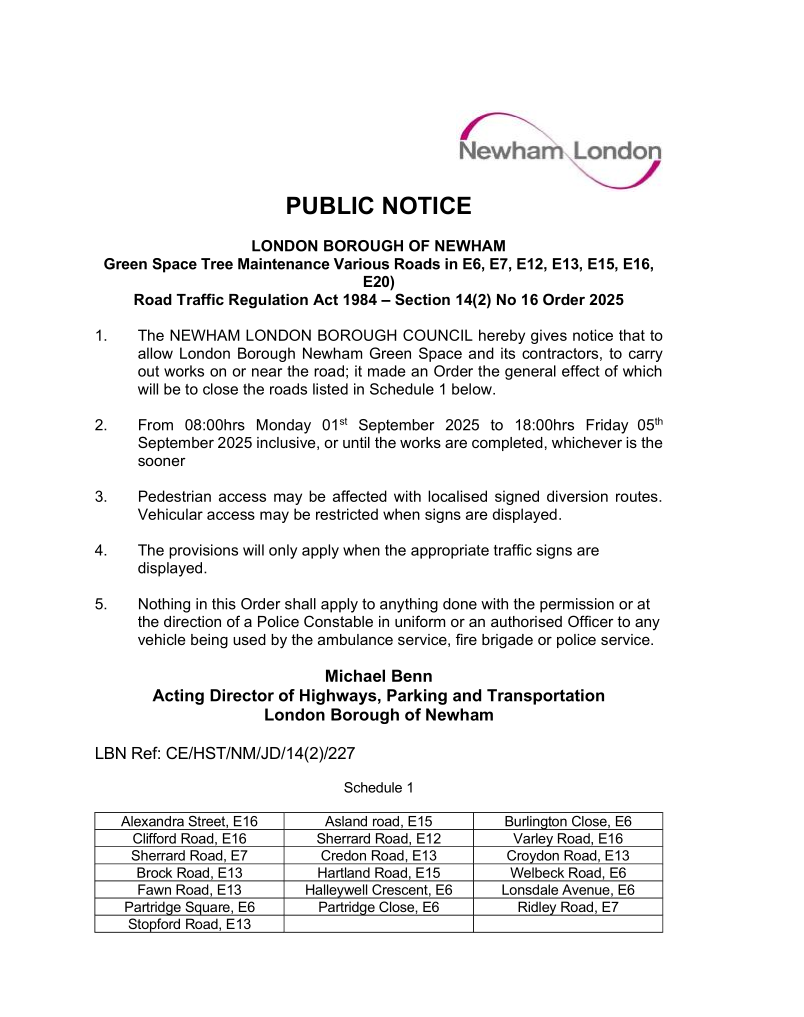
This Order does not restrict or change parking arrangements.

'..the general effect of which will be to close the roads listed in Schedule 1 below'.

Nothing to do with parking, let alone introducing waiting restrictions.

Ha yes, I completely missed that it was different to the printed one on the sign. In their evidence pack, this is the only Order they have attached, so it seems to be a mistake on their part.

12
Pl post the TTMO and the core TMO* which are included in their evidence pack as well as the photo(s) of the signage in the pack.

*- this is important because as far as I can tell from previous posts the TTMO refers to the core Order as regards its scope and we therefore need to see how this is framed and how it deals with 'Traffic Signs'.

As regards their reference to 'semantic distinction', the law thinks otherwise:


The Road Traffic (Temporary Restrictions) Procedure Regulations 1992

https://www.legislation.gov.uk/uksi/1992/1215/contents/made


In their 54 page PDF that they have submitted, this is the only TTMO that I can see, which is what was printed and attached to the yellow sign. It is also the only piece of evidence categorised under "Evidence Type B: Case Summary & Traffic Management Order"

Am I right in thinking that this actually is the TTMO and they have not provided the core TMO - is this something I can use against them?


13
Bump - today is the last day  :-\

----

Sent off an appeal with an AI-assisted document

14
I'm searching the tribunal register of appeals for anything that I can use as ammunition. Is there an easy way to search for similar contraventions? There is a contravention field on the search query, but it seems that the values are not standardised.

https://londontribunals.org.uk/ords/pwslive/f?p=14952:60::INITIALISE::::&cs=35A_wQdA9KZ0zDcZUno_tY96rvm3_dI6vCQnuJIYIxgbmeIdA-75g9TXyLVXeJC_P6p54A-Md44vDKlYmEwHr5Q

15
Thank you for the case reference, I will include this in my evidence.

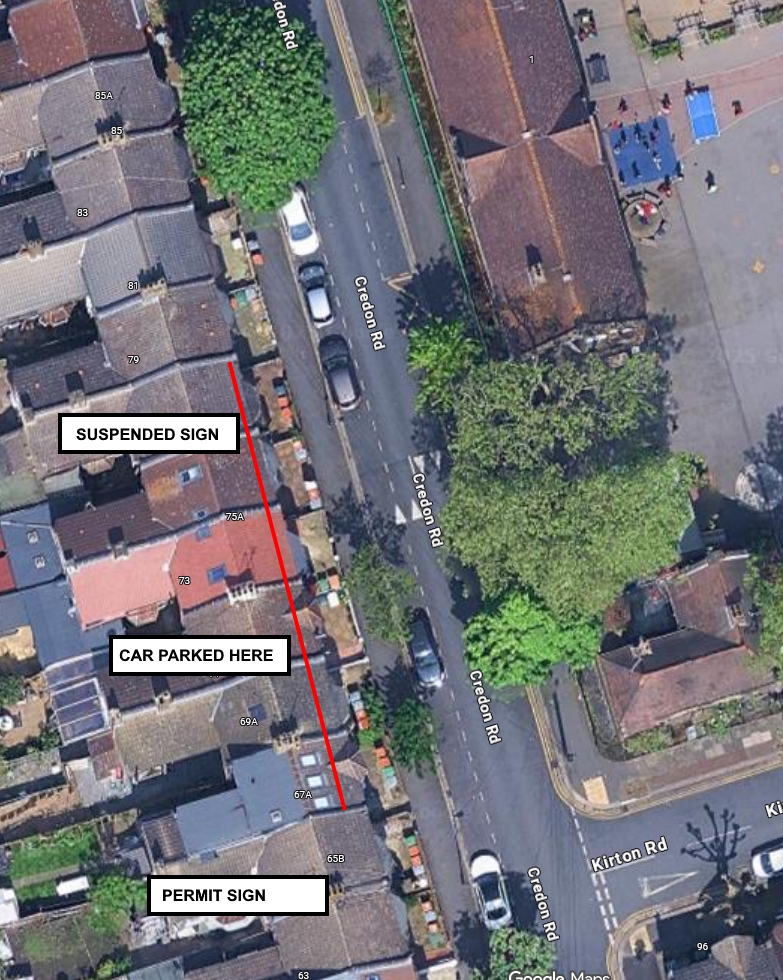
Regarding the relative position of the sign, I shared a map I made earlier, sharing again now:

There was no suspended sign in front of me:


Pages: [1] 2 3 ... 5